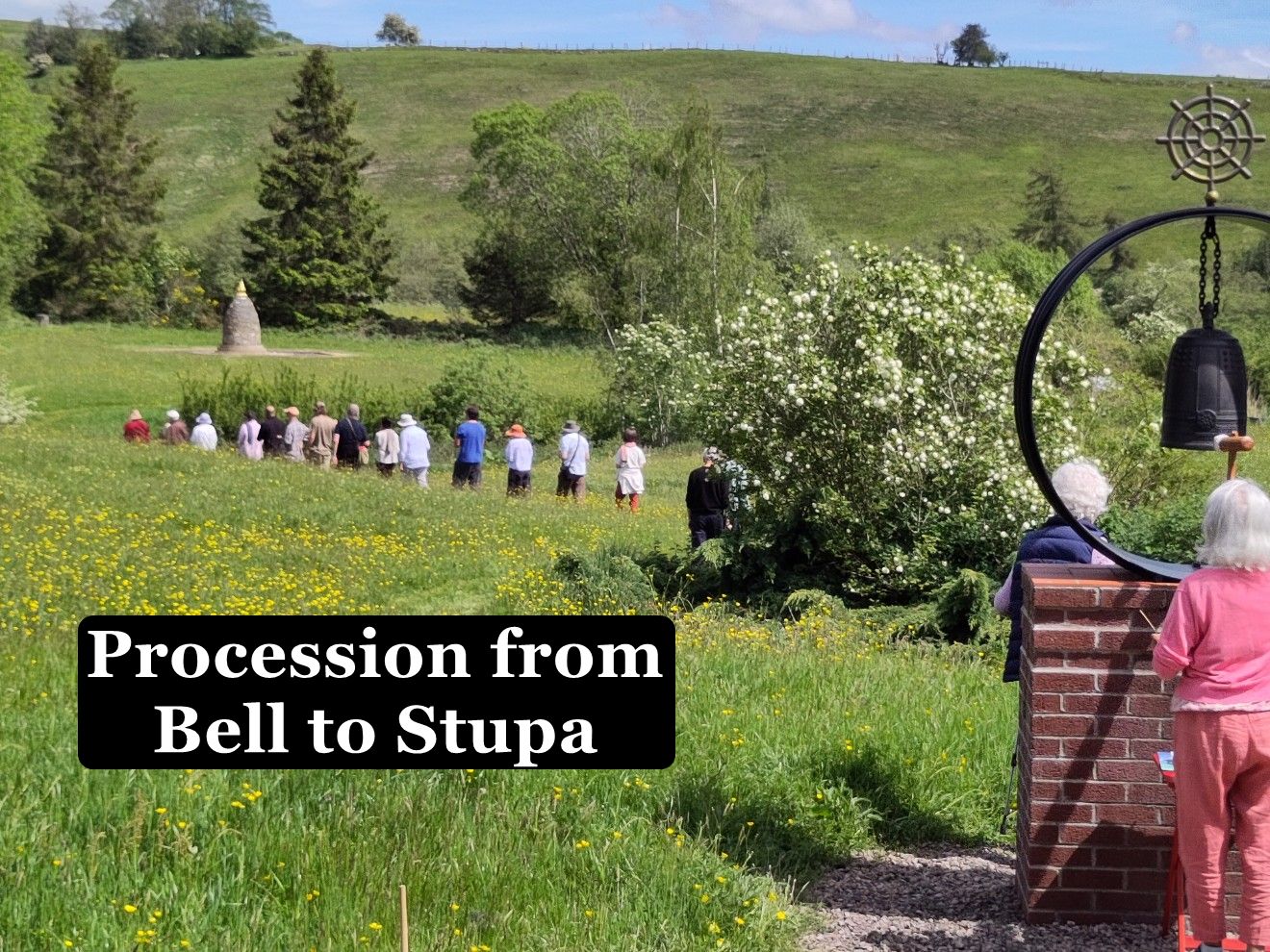
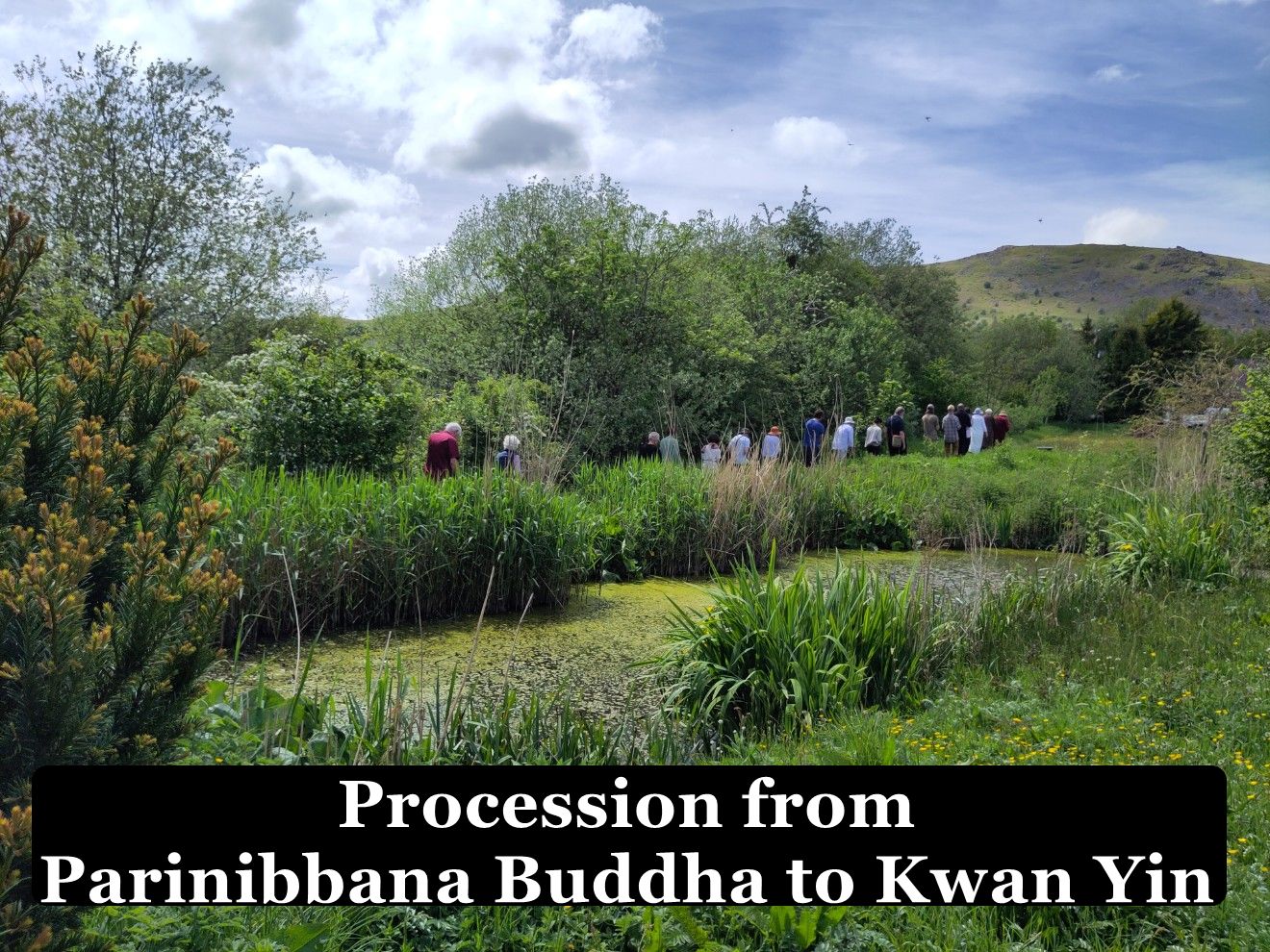
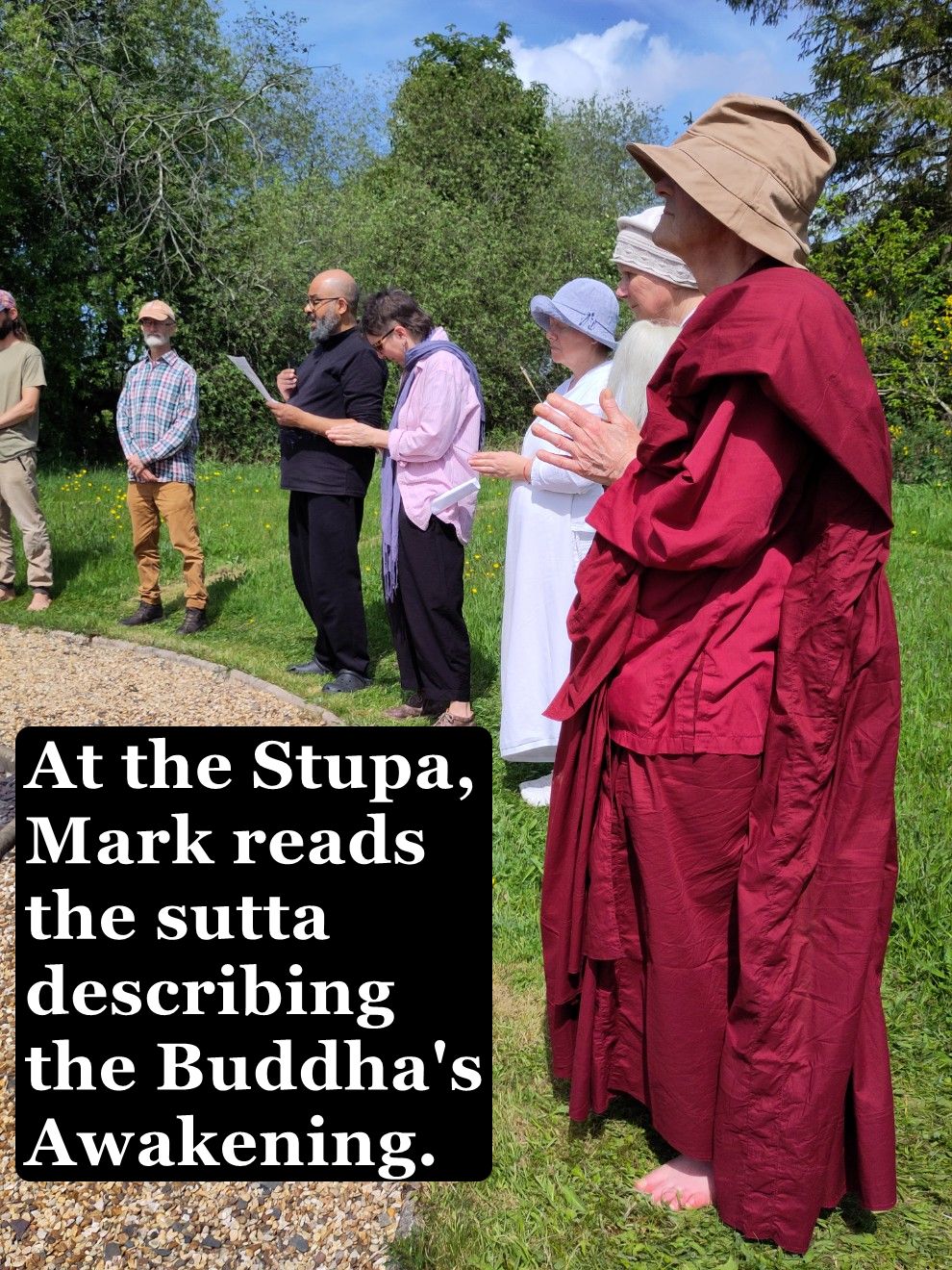
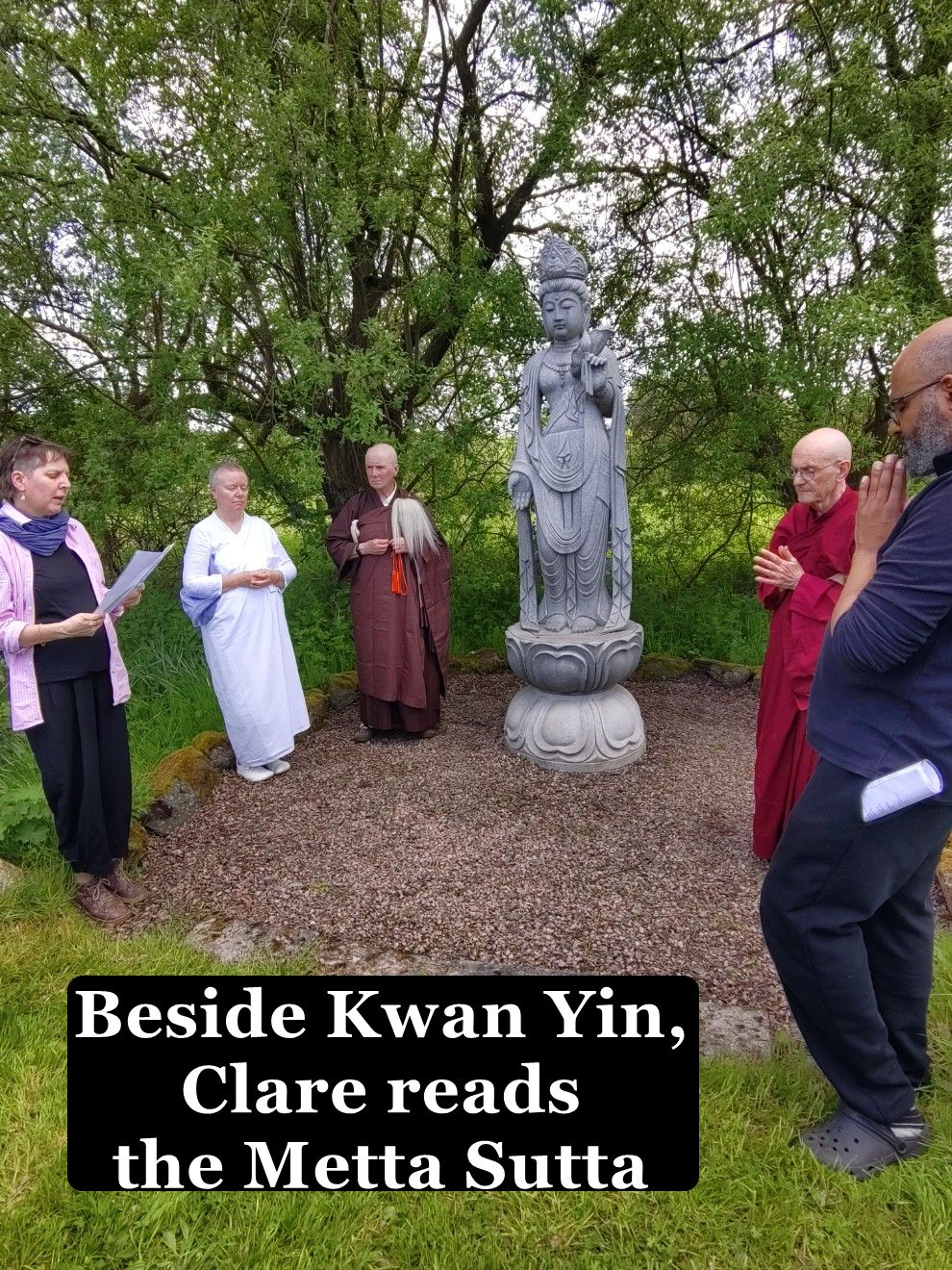
Newsbyte

September NEWSBYTE 2026
 

Trust all is well!

People keep disappearing from the mailing list. We have realised this happens when an existing subscriber applies for a retreat and selects the checkbox to subscribe to the Newsbyte. If this happens to you, and you realise you haven't received a Newsbyte, please email us here and we'll fix your subscription.


All Past Tips


For calendar and assistant opportunities, see below.

Tip o' the Day


Are Grief and Sorrow the same?

Bhante Bodhidhamma

(Difficulty reading text? Press Ctrl +)

Assistants needed for
Weekend Retreats in September
Fri 18 - Sun 21 with Mark Arthur
Apply Here.
Fri 25 - Sun 27 with Carl Fooks
Apply Here.


If you have a devotional heart, download the Buddhist Compass App.

Calendar for Autumn is also open for Applications

Full Moon Celebration Sunday 06 September

Diary

Our house in Bishops Castle is off the market while we repaint and possibly replace ceilings damaged by the leaking water tank in the roof.

Once up for sale again, it is a very good purchase for anyone who wants to live near Satipanya. Bishops Castle has all the amenities, even a Cottage Hospital and there's an active Thich Nhat Hanh group in the town.

But the good news is that we completed the purchase of The Homestead in White Grit on Friday, a Full Moon Day. Slowly but surely, the new order is establishing itself.

Neighbourliness!

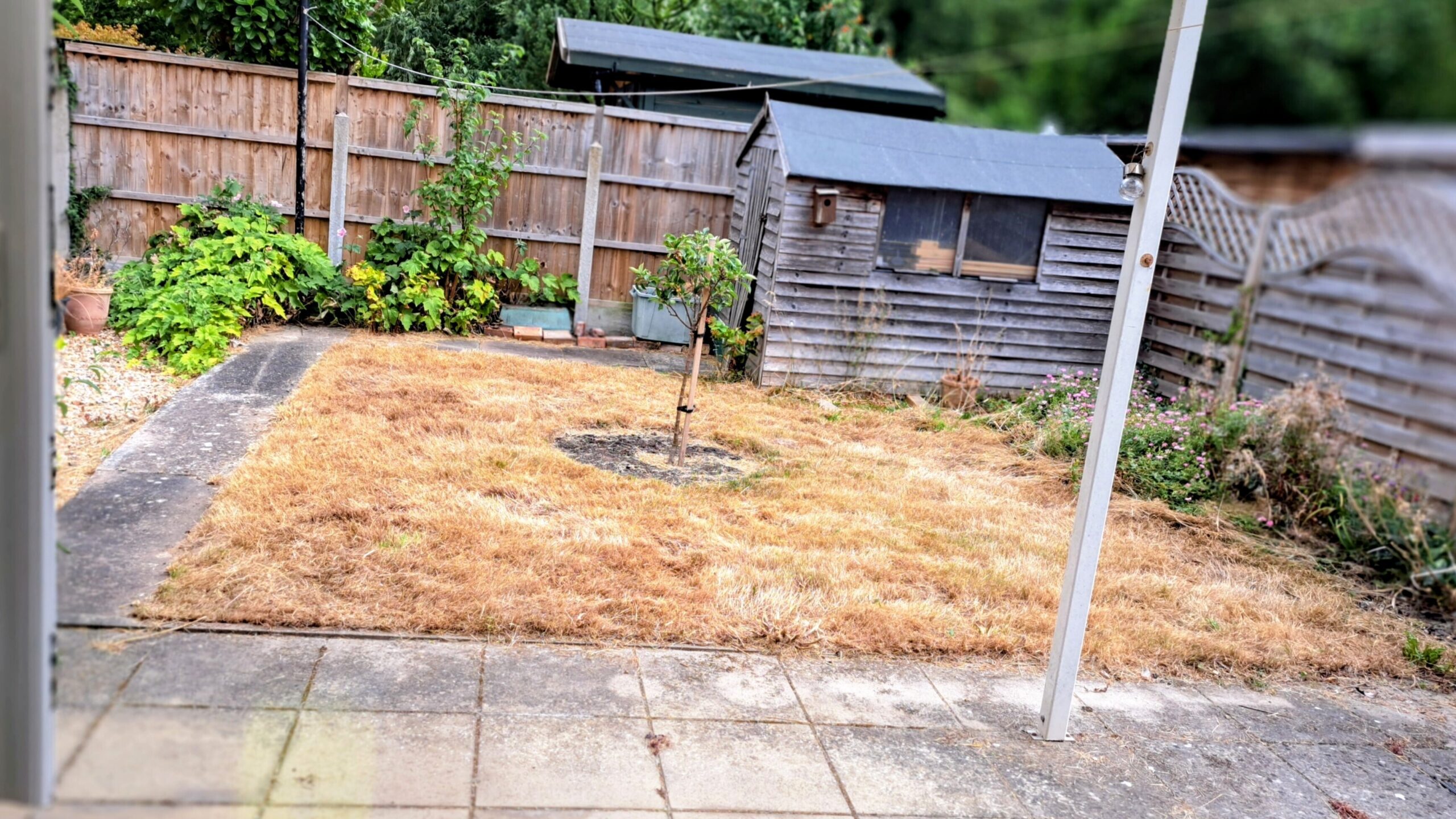
My back garden is about 5 meters in length. Looming up over the fence is a broad laural bush which sits directly in my line of vision. I want it cut down to fence level.

My neighbours garden is well over 25 meters long and stretches behind three bungalows. I caught Paul washing his car and asked if the laural could be cut back. He was quick to say yes.

One day, some weeks later, he began cutting the sides to make the laural a little thinner. As I spoke to him through the fence, thanking him, I could feel the annoyance of his wife. It is thinner but growing taller.

I wrote a letter saying that I was willing to pay for it being done and inviting him and his wife to visit and check out my situation from themselves.

He appeared that same day with his dog and in an angry mood, saying he had filled so many bins already and that I need to give him time and that he would cut it but only by two feet from the top. I simply said, I'd be happier with three. I didn't think it was the time to invite him in.

I let it lie a couple of days and wrote again. I apologised for any confusion, but said I was disappointed. I've asked them again to visit at their convenience and to sit in the garden and conservatory to see the situation from my point of view. After all, I argued this was the essence of neighbourliness. I have asked the bush to be cut back down to the fence. I have offered to get the deed done and to buy a sapling for any other bush or tree they may want to plant. 

Silence!
Great to be back in the city!
La lotta continua!

I am away soon on my personal retreat to Metta Vihara in South Germany again. This year a little earlier and will be returning mid-November.

Announcements

Daily Life Course: This years on-line course is titled "Rooted in Mud" and looks at the many ways our path to liberation can spring from the mud of deep sorrows as well as the minor miseries of everyday life. The course includes suggested exercises for home practice and the opportunity to share your reflections with other students on the Satipanya Forum. The first run of the 7 week course started mid-May and it  will run again in October. For further information or to register please contact Noirin. 

Meeting in London: Satipanya London Sangha is a small but growing community of friendly and supportive meditators meeting in person at a peaceful community garden near King's Cross station for group sits and lighthearted discussions.

If you'd like to attend upcoming meetings in London and practice vipassana in the tradition of Mahasi Sayadaw then email Maz and ask to be added to the mailing list.

Regular Online Meetings:

Meditation Hall on Zoom: Join us for your daily meditation -  Info.

Satipanya Spiritual Companions: An informal meditation group meets on a monthly basis via Zoom for a full day of meditation. Email Magda for details at [email protected]

Online Study Group: 
This collaborative online group studies various dhamma topics across multiple traditions — so, not just Mahāsi practice. Carl says: We warmly extend an invitation to any practitioner who would like to join us. Currently meeting on the second and fourth Sundays of each month at 10:20am - around midday. Please contact Carl at [email protected] for further information.

Full Moon Celebrations: Join 20.00 to 21.00 UK time on the Sunday closest to the Full Moon. Bhante gives a short dhamma talk, followed by a 30-min sitting, refuges and precepts and we end by reading and chanting the metta sutta.  For date of next Celebration.   
 
Opening to the Impact of the Climate Emergency:  Following on from the Zoom with Gwen Sanderson and Bhante Bodhidhamma in 2023, there are two options for ongoing engagement:
  • Gwen Sanderson is facilitating monthly Climate and Dhamma Conversations which are held using Zoom. Email Gwen for further information or to register. 
  • Noirin Sheahan has set up a Satipanya Forum focussing on the Six Maxims (ethical training to prepare for the social and environmental consequences of climate change). Contact Noirin for further info or to register.  

Karuna Book: Every morning at puja we call the names of those who are sick or dying, or are having a hard time.

Mudita Book: Every evening at puja we call the names of those who have something to rejoice.

Satipanya Courses

Vipassana as taught by the Mahasi Sayadaw of Burma

The Mahasi Sayadaw of Burma, one of the most influential vipassana insight meditation teachers of the last century, developed techniques to help us maintain moment to moment mindfulness from the instant we awake to the instant we fall asleep.

This leads not only to spiritual insights into our true, unborn-undying essence, but also, equally important, to the purification of the heart. So that we not only become wiser but more caring, generous, joyous and compassionate.

Applying the techniques on this retreat we follow a robust schedule, but meditators can modulate their practice to fit their level of experience, even absolute beginners. The accent is on relaxation and curiosity, rather than striving and concentration. And regular teacher contact, daily Q&A and personal interviews ensures students are supported throughout.

The retreat ends with advice on how to bring the practice into ordinary daily life to enhance our relationships and give spiritual meaning to our work and everyday tasks.

Assistants Needed

N.B. All the courses are serviced by assistants.

As assistant you have the opportunity to serve others. It can be a way of expressing gratitude for the gift of Dhamma. Although the morning is mainly taken up with breakfast preparation and cooking, the rest of day is for practice.

You can see the menus here (PDF).

As an assistant, we do not expect payment of the deposit or make a donation because you have kindly offered your time.

However, your commitment is essential, for the course would be very difficult to run without an assistant and may indeed have to be cancelled.

If you are interested, follow this link: Course Assistant

For info. about retreats and teachers see website: www.satipanya.org.uk
See drop down menus: especially About Us, Teachings and Retreats

Would you like to come and assist on a course?

See calendar on website for up-to-date assistant need.

Satipanya Calendar 2026


Please apply only when you are certain to come.

Are Grief and Sorrow the same?

Bhante Bodhidhamma

I went to Panditarama in Yangon during the winter of the Millennium. There I saw a statue of the Buddha in a mudra, a posture, I had not seen before. His right hand was pointing to his heart. I asked what the meaning was and I was told it symbolised the sadness the Buddha felt at the loss of his two chief disciples, Sariputta and Mogallana. How could the Buddha feel sad? After all shouldn't the virtue of total acceptance of the way things are, prevent such a ‘reaction'.

I know of an elderly lady who could not stop grieving the loss of her son who had died five years before. It was suggested she might be confusing grief with sorrow. By sorrow is meant the sadness one feels at another's misfortune and grief refers to the loss of someone we are attached to. It can be complicated with anger, guilt and remorse, all dependent on the particulars of the situation.

When someone we love dearly leaves us or dies, it leaves an open wound in the heart. Someone whom we depended on to bring us comfort in sadness and joy in success was gone. And so the happiness we felt when we did the same for them. But this comfort and joy and happiness, though quite natural can become dependencies. And that's what we mean by attachment. Now they have gone we lose on two counts and that loss we experience as grief.

If then the amount of grief is believed to be the measure of our love, every time the lady’s grief lessened, she would mistakenly feel her love for her son was also lessening. Guilt would arise and so grief would have to be pumped back up. Because of this misunderstanding her grief would never end. She was asked if her son would be happy to know of her suffering. Would he not want her to accept the situation and to wish him well. She believed in an afterlife, so it was suggested she perform a ritual such as writing him a letter expressing her sorrow at his passing, but that she was ready to accept the situation and wish him well on his onward journey. And then perhaps to read it out at his grave. And then to dispose of the letter in a way that brought closure. Even within a week her grief had gone and she was happy when she remembered the relationship she had with her son.

The Buddha expressed his sorrow at the loss of Sariputta and Maha Moggallana, ‘This assembly, O bhikkhus, appears indeed empty to me, now that Sariputta and Maha Moggallana have passed away.’  But he did not grieve for them. He was expressing his sadness for the Sangha that the two most important teachers had died and for himself at the loss of two close members. (It is reported that Mogallana was murdered by another group of mendicants since he was converting some of their members.)

There is also the occasion when at the end of his days he gave his ‘elephant look’ i.e turning his full body to look at Vesali and remarked to Ananda that this would be the last time he would see Vesali. There is a suggestion of sadness.

What then might sorrow be? When we bring to mind the enormous and growing suffering in the world caused by ideological wars, the climate crisis bearing down upon us, the destruction of nature and disappearance of species, there may arise all sorts of mental states from despair, and in spite of despair a daring to hope, anger and the will to action only to find the crushing acceptance of impotence over the bottomless greed and lust for power of overwhelming vested interests. Yet there may come a time, exhausted, we rest in the solitude of sorrow. For there within that profound sadness there comes the salve of total acceptance. This is the way it is! This is what it is! After all this is the world of Samsara, a swirl of consciousnesses driven by greed, hatred and fake identities. If we stay there in silence long enough within this inner composure, we will find an unexpected solace and a subtle joy arising and a desire to re-engage. For true sorrow does not drown in pitying sadness, but is a catalyst for compassion and cannot remain passive. It demands we move back into the suffering world. And when we do, we find ourselves on firmer ground, no longer wearied by despair, wishful hoping, anger, grief and powerlessness.

Knowing this distinction, makes grief a little easier to distinguish from sorrow. For the grief we feel will equal the measure of attachment. In our vipassana practice, we allow that grief to manifest, but we do not allow the mind to fantasise. We simply sit within the feeling allowing it to discharge and we may find ourselves crying. Grief is a very complex state and may include times of anger, fear and depression. We have to embrace all these mental states with a sense of care and patiently bear them till they exhaust themselves... and they will.
 
Francis Wells: The Wild Edge of Sorrow – investigates the ‘Five Gates of Grief' and the role of ritual.
Symphony of Sorrow by Henryk Górecki (Polish composer) I find this difficult to listen to. The sorrow is intense.
Górecki's most popular piece is his Third Symphony, also known as the "Symphony of Sorrowful Songs" (Symfonia pieśni żałosnych). The work is slow and contemplative, and each of its three movements is for orchestra and solo soprano. The libretto for the first movement is taken from a 15th-century lament, while the second movement uses the words of a teenage girl, Helena Błażusiakówna (Helena Błażusiak), which she wrote on the wall of a Gestapo prison cell in Zakopane to invoke the protection of the Virgin Mary.[45]
The third uses the text of a Silesian folk song which describes the pain of a mother searching for a son killed in the Silesian Uprisings. The symphony's dominant themes are motherhood and separation through war. While the first and third movements are written from the perspective of a parent who has lost a child, the second is from that of a child separated from a parent. Wikipedia


If you fail to receive a monthly NEWSBYTE, please look in spam, or reestablish the email by filling in the MAILING LIST form at the bottom of the front page of the website.

Many thanks.

Finally, please forward this email if you know someone who may be interested. Thanks.

Metta
Onward
Bodhidhamma

SATIPANYA  BUDDHIST TRUST
www.satipanya.org.uk
Directors Jim Tibby  Richard Benjamin  Noirin Sheahan  Mike Regan  Gwen Sanderson
Limited Company Number 05924965 Registered Charity Number 1116668
Satipanya Buddhist Trust Satipanya White Gritt, Minsterley Shrewsbury, Shropshire SY5 0JN United Kingdom
T: +44 (0)1588 650752
info: [email protected]

August NEWSBYTE 2026
 

Trust all is well!

People keep disappearing from the mailing list. We have realised this happens when an existing subscriber applies for a retreat and selects the checkbox to subscribe to the Newsbyte. If this happens to you, and you realise you haven't received a Newsbyte, please email us here and we'll fix your subscription.


All Past Tips


For calendar and assistant opportunities, see below.

Tip o' the Day


Mindful Accidents?

Bhante Bodhidhamma

(Difficulty reading text? Press Ctrl +)

Assistants needed for
Weekend Retreats in September
Fri 18 - Sun 21 with Mark Arthur
Apply Here.
Fri 25 - Sun 27 with Carl Fooks
Apply Here.

Retreat places also available for both weekends

If you have a devotional heart, download the Buddhist Compass App.

Calendar for Autumn is also open for Applications

Full Moon Celebration Sunday 09 August

Diary (Bhante) 

You will know that we are in the process of buying a bungalow in White Grit to house a manager, not twenty minutes walk away from Satipanya. As usual the process is taking its time.You will also know that Jim Tibby has volunteered to take on the task of managing the property.

You will also know that we are trying to sell the property we bought in Bishops Castle that will finance this buy. The property, we have discovered is somewhat jinxed. When the bath was used, the overflow outlet had no pipe connection, so the water descended into the entrance and soaked the electrical box. Recently the water tank in the roof began to leak. Unfortunately we didn't find out for some time. So now we have to wait till the walls and carpets dry and then we have to redecorate.

On top of that we have President Trump (I'm restraining from the use epithets!) starting an ill-advised war on Iran. This has had a real dampening effect on the housing market. And to date we have had one interested party! So please send some powerful good wishes.

Putting all that to one side, I have neighbours who are shining examples of neighbourliness. Anne is forever beating me at bringing in the bins from the road. And her husband, Richard is always ready to help. This Saturday morning he saw me struggling to cut the grass with the mower that had been left by the sellers. I've let the grass grow so the patch will become a meadow in time. He warned me it would burn out. And he could do it with his powerful model. In he came with a petrol driven state of the art mower and in half an hour cut the grass and stamped it into the bin. Literally, he climbed into the bin and jumped up and down to squash down all the grass. And he's all of seventy! Unfortunately, they've put their house up for sale and want to move to Anglesey in north Wales. I think I am going to miss them.

BEFORE Richard


AFTER Richard


Announcements

Compassionate Inquiry: Ayya Anopama is a Theravada Buddhist nun who has trained in Mahasi as well as other meditation practices. Ayya is now training in Compassionate Inquiry (CI) and from July to September 2026 will be offering free one-to-one CI sessions which can be held in in English, Spanish and German.  For more information or to contact Ayya see here.

Daily Life Course: This years on-line course is titled "Rooted in Mud" and looks at the many ways our path to liberation can spring from the mud of deep sorrows as well as the minor miseries of everyday life. The course includes suggested exercises for home practice and the opportunity to share your reflections with other students on the Satipanya Forum. The first run of the 7 week course started mid-May and it  will run again in October. For further information or to register please contact Noirin. 

Sharing the Path, Satipattthana Studies Part 1 has been published as an ebook, kindle, paperback and can be dowloaded as a PDF. Based on Noirin's Daily Life courses over previous years and supplemented by students' reflections, the book offers a study-practice guide to the Buddha's teaching on Mindfulness of Body, Feeling and Mind. Many thanks to Therese Caherty for editing. Further info here.

Meeting in London: Satipanya London Sangha is a small but growing community of friendly and supportive meditators meeting in person at a peaceful community garden near King's Cross station for group sits and lighthearted discussions.

If you'd like to attend upcoming meetings in London and practice vipassana in the tradition of Mahasi Sayadaw then email Maz and ask to be added to the mailing list.

Regular Online Meetings:

Meditation Hall on Zoom: Join us for your daily meditation -  Info.

Satipanya Spiritual Companions: An informal meditation group meets on a monthly basis via Zoom for a full day of meditation. Email Magda for details at [email protected]

Online Study Group: 
This collaborative online group studies various dhamma topics across multiple traditions — so, not just Mahāsi practice. Carl says: We warmly extend an invitation to any practitioner who would like to join us. Currently meeting on the second and fourth Sundays of each month at 10:20am - around midday. Please contact Carl at [email protected] for further information.

Full Moon Celebrations: Join 20.00 to 21.00 UK time on the Sunday closest to the Full Moon. Bhante gives a short dhamma talk, followed by a 30-min sitting, refuges and precepts and we end by reading and chanting the metta sutta.  For date of next Celebration.   
 
Opening to the Impact of the Climate Emergency:  Following on from the Zoom with Gwen Sanderson and Bhante Bodhidhamma in 2023, there are two options for ongoing engagement:
  • Gwen Sanderson is facilitating monthly Climate and Dhamma Conversations which are held using Zoom. Email Gwen for further information or to register. 
  • Noirin Sheahan has set up a Satipanya Forum focussing on the Six Maxims (ethical training to prepare for the social and environmental consequences of climate change). Contact Noirin for further info or to register.  

Karuna Book: Every morning at puja we call the names of those who are sick or dying, or are having a hard time.

Mudita Book: Every evening at puja we call the names of those who have something to rejoice.

Satipanya Courses

Vipassana as taught by the Mahasi Sayadaw of Burma

The Mahasi Sayadaw of Burma, one of the most influential vipassana insight meditation teachers of the last century, developed techniques to help us maintain moment to moment mindfulness from the instant we awake to the instant we fall asleep.

This leads not only to spiritual insights into our true, unborn-undying essence, but also, equally important, to the purification of the heart. So that we not only become wiser but more caring, generous, joyous and compassionate.

Applying the techniques on this retreat we follow a robust schedule, but meditators can modulate their practice to fit their level of experience, even absolute beginners. The accent is on relaxation and curiosity, rather than striving and concentration. And regular teacher contact, daily Q&A and personal interviews ensures students are supported throughout.

The retreat ends with advice on how to bring the practice into ordinary daily life to enhance our relationships and give spiritual meaning to our work and everyday tasks.

Assistants Needed

N.B. All the courses are serviced by assistants.

As assistant you have the opportunity to serve others. It can be a way of expressing gratitude for the gift of Dhamma. Although the morning is mainly taken up with breakfast preparation and cooking, the rest of day is for practice.

You can see the menus here (PDF).

As an assistant, we do not expect payment of the deposit or make a donation because you have kindly offered your time.

However, your commitment is essential, for the course would be very difficult to run without an assistant and may indeed have to be cancelled.

If you are interested, follow this link: Course Assistant

For info. about retreats and teachers see website: www.satipanya.org.uk
See drop down menus: especially About Us, Teachings and Retreats

Would you like to come and assist on a course?

See calendar on website for up-to-date assistant need.

Satipanya Calendar 2026


Please apply only when you are certain to come.

Mindful Accident?

Bhante Bodhidhamma

It was the third Saturday in June and I woke relieved. My home-made head bandage was still firmly attached to my head and no sign of blood.

I thought I wouldn’t be able to sleep since the 2cm long cut at the back of my skull is just where I place my head on the pillow, but I was able to place the pillow beneath it and I slept like a log.

Looking out onto my overgrown lawn – I’m developing a meadow … seriously – I’m wondering what lesson is to be learnt.

Way back in 2007, I woke with the room barrelling around me. I staggered to the toilet to splash my face and fell back into bed. The next morning I rang 111 and the nurse told me to go and see the doctor if it happened again. Well, it didn’t, but I’d lost a lot of my sense of balance. I’m often gently moving off centre before I notice it.

And that’s what happened late evening yesterday. I was trying out an exercise bike a friend had given to me. As I got off, I lost balance. As I fell backwards, I grabbed the bike only to find it was helping me on the way down. I then fell against the swivel chair only to be launched at the filing cabinet. It’s a cheap one so the metal is ‘soft’. Quite a bang and I caught the back of my head on the handle.

I lay there for a while recognising that was a nasty bump and waiting to see if I saw stars or lost consciousness. Nothing happened so I got up. I began to get a mild headache, so it really was a bang on the head. I went to rub the sore feeling on my head only to find my hand covered in blood!

I had bought a small packet of small Elastoplasts that would not do. So I rolled up a sheet of kitchen paper and Celotaped it to my head. And that’s what I lay on my pillow.

So what is the lesson? I could be harsh. Be careful! And go easy, you silly old …!

Now I dare say you will be wanting to say, ‘Oh Bhante, you have to be more mindful’.

But I can assure I was very mindful getting off that bike because it was awkward. It has, of course, made me more aware of my disability.

So, the question arises, ‘Can you have an accident while being mindful?’

To understand why that can happen we have to recall the Buddha’s understanding of how events occur. Every moment is a meeting of past causes into presenting conditions. This is the Specific Law of Conditionality, Idappaccayatā.

Whenever we are crossing a busy road, each step enters into a new environment. Such may be our concern, our attention is on the moving traffic and we have not noticed the pothole next to the kerb. That hole has been waiting a long time for someone’s foot to acknowledge its presence. Luckily our forward stumble is automatically halted, but it leaves us with a nasty shock. A normal reaction. And that’s when we smile, recalling to mind the Idappaccayatā.

We work with ever changing, never repeating, momentary conditions.


If you fail to receive a monthly NEWSBYTE, please look in spam, or reestablish the email by filling in the MAILING LIST form at the bottom of the front page of the website.

Many thanks.

Finally, please forward this email if you know someone who may be interested. Thanks.

Metta
Onward
Bodhidhamma

SATIPANYA  BUDDHIST TRUST
www.satipanya.org.uk
Directors Jim Tibby  Richard Benjamin  Noirin Sheahan  Mike Regan  Gwen Sanderson
Limited Company Number 05924965 Registered Charity Number 1116668
Satipanya Buddhist Trust Satipanya White Gritt, Minsterley Shrewsbury, Shropshire SY5 0JN United Kingdom
T: +44 (0)1588 650752
info: [email protected]

JUNE NEWSBYTE 2026
 

Trust all is well!

People keep disappearing from the mailing list. We have realised this happens when an existing subscriber applies for a retreat and selects the checkbox to subscribe to the Newsbyte. If this happens to you, and you realise you haven't received a Newsbyte, please email us here and we'll fix your subscription.


All Past Tips


For calendar and assistant opportunities, see below.

Tip o' the Day


End Game

Bhante Bodhidhamma

(Difficulty reading text? Press Ctrl +)

Assistants Needed!!!
From 15 August onward
***********************************
If you have a devotional heart, download the Buddhist Compass App.

Calendar for Autumn is also open for Applications

Full Moon Celebration Sunday 05 July

Diary (Nóirín) 

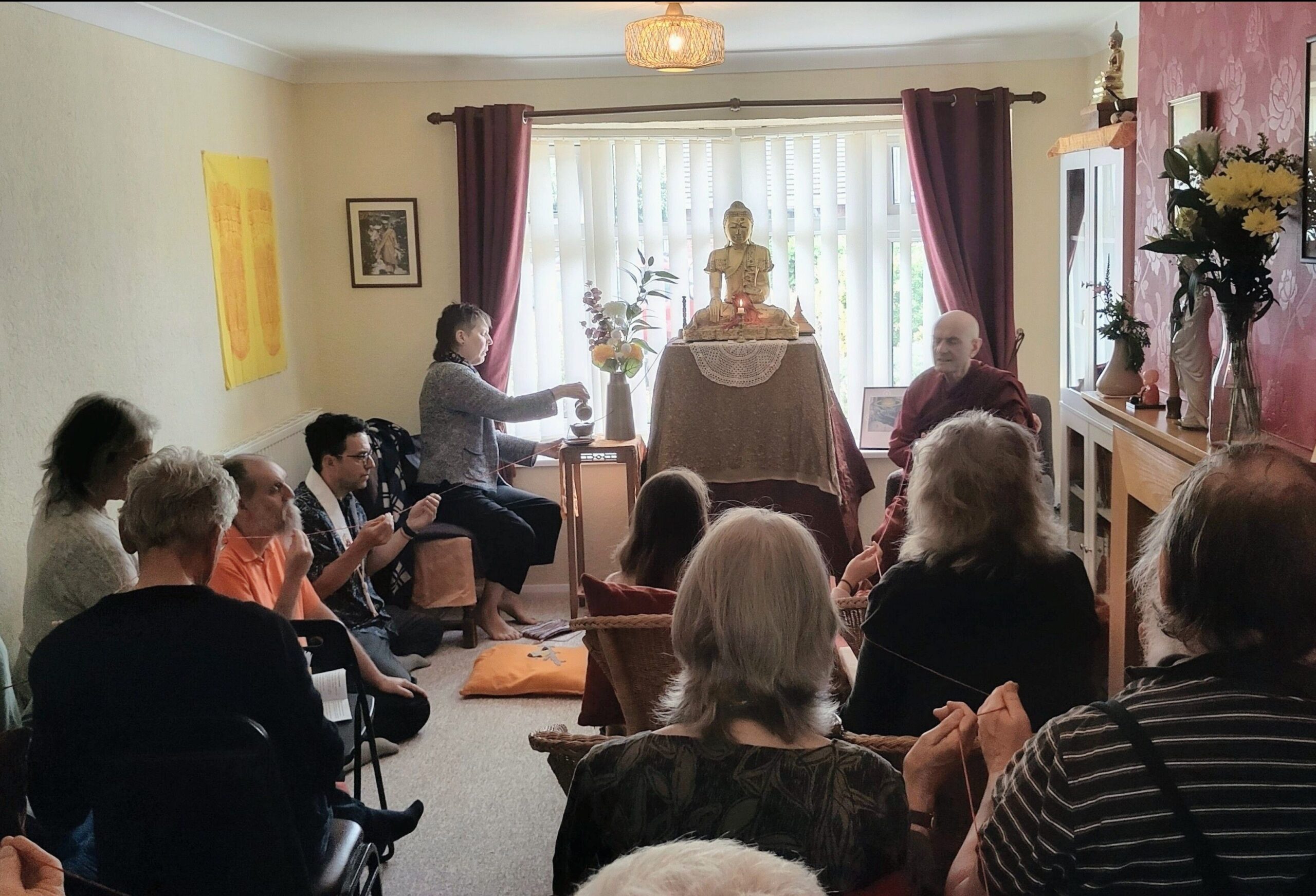
Just a week after Buddha Day we celebrated the opening of the new Shrewsbury Vihara where Bhante now lives.
We started in the traditional way, passing a ball of string around the room so we could each hold a thread to symbolize connection to one another and the Vihara. Clare poured water to symbolize 'sharing of merits' as we chanted the metta sutta. 

       
Bhante then spoke about his motivation for moving out of Satipanya which he has written about again in this month's Tip. He invited people to use the vihara as somewhere to come for meditation or simply for some peace and quiet, e.g. during a day's shopping or business in Shrewsbury. Contact him beforehand to arrange.  
Jim Tibby (Chairman of the Trust) thanked Bhante for his wonderful work over the past 20 years, transforming Satipanya from a simple family house to a thriving retreat centre. Watch a video of Jim's speech here.
Just before we broke for lunch, Bhante offered each of us bracelets along with the Blessings of the Three Buddhas.  It was a joyful occasion as we wished Bhante well in his new home and new phase of life. 
       

Announcements

Compassionate Inquiry: Ayya Anopama is a Theravada Buddhist nun who has trained in Mahasi as well as other meditation practices. Ayya is now training in Compassionate Inquiry (CI) and from July to September 2026 will be offering free one-to-one CI sessions which can be held in in English, Spanish and German.  For more information or to contact Ayya see here.

Daily Life Course: This years on-line course is titled "Rooted in Mud" and looks at the many ways our path to liberation can spring from the mud and mire of deep sorrows as well as the minor miseries of everyday life. The course includes suggested exercises for home practice and the opportunity to share your reflections with other students on the Satipanya Forum. The first run of the 7 week course started mid-May and it  will run again in October. For further information or to register please contact Noirin. 

Personal Retreat: Our house in Bishops Castle "Sativasa" remains open for personal retreats. Suitable only for those with a well-established meditation practice. Come for a week or longer. Retreats are self catering so the first day might need to be spent shopping, cooking etc. See here for more info. To apply email Bhante or Noirin.

Sharing the Path, Satipattthana Studies Part 1 has been published as an ebook, kindle, paperback and can be dowloaded as a PDF. Based on Noirin's Daily Life courses over previous years and supplemented by students' reflections, the book offers a study-practice guide to the Buddha's teaching on Mindfulness of Body, Feeling and Mind. Many thanks to Therese Caherty for editing. Further info here.

Meeting in London: Satipanya London Sangha is a small but growing community of friendly and supportive meditators meeting in person at a peaceful community garden near King's Cross station for group sits and lighthearted discussions.

If you'd like to attend upcoming meetings in London and practice vipassana in the tradition of Mahasi Sayadaw then email Maz and ask to be added to the mailing list.

Regular Online Meetings:

Meditation Hall on Zoom: Join us for your daily meditation -  Info.

Satipanya Spiritual Companions: An informal meditation group meets on a monthly basis via Zoom for a full day of meditation. Email Magda for details at [email protected]

Online Study Group: 
This collaborative online group studies various dhamma topics across multiple traditions — so, not just Mahāsi practice. Carl says: We warmly extend an invitation to any practitioner who would like to join us. Currently meeting on the second and fourth Sundays of each month at 10:20am - around midday. Please contact Carl at [email protected] for further information.

Full Moon Celebrations: Join 20.00 to 21.00 on the Sunday closest to the Full Moon. Bhante gives a short dhamma talk, followed by a 30-min sitting, refuges and precepts and we end by reading and chanting the metta sutta.  For date of next Celebration.   
 
Opening to the Impact of the Climate Emergency:  Following on from the Zoom with Gwen Sanderson and Bhante Bodhidhamma in 2023, there are two options for ongoing engagement:
  • Gwen Sanderson is facilitating monthly Climate and Dhamma Conversations which are held using Zoom. Email Gwen for further information or to register. 
  • Noirin Sheahan has set up a Satipanya Forum focussing on the Six Maxims (ethical training to prepare for the social and environmental consequences of climate change). Contact Noirin for further info or to register.  

Karuna Book: Every morning at puja we call the names of those who are sick or dying, or are having a hard time.

Mudita Book: Every evening at puja we call the names of those who have something to rejoice.

Satipanya Courses

Vipassana as taught by the Mahasi Sayadaw of Burma

The Mahasi Sayadaw of Burma, one of the most influential vipassana insight meditation teachers of the last century, developed techniques to help us maintain moment to moment mindfulness from the instant we awake to the instant we fall asleep.

This leads not only to spiritual insights into our true, unborn-undying essence, but also, equally important, to the purification of the heart. So that we not only become wiser but more caring, generous, joyous and compassionate.

Applying the techniques on this retreat we follow a robust schedule, but meditators can modulate their practice to fit their level of experience, even absolute beginners. The accent is on relaxation and curiosity, rather than striving and concentration. And regular teacher contact, daily Q&A and personal interviews ensures students are supported throughout.

The retreat ends with advice on how to bring the practice into ordinary daily life to enhance our relationships and give spiritual meaning to our work and everyday tasks.

Assistants Needed

N.B. All the courses are serviced by assistants.

As assistant you have the opportunity to serve others. It can be a way of expressing gratitude for the gift of Dhamma. Although the morning is mainly taken up with breakfast preparation and cooking, the rest of day is for practice.

You can see the menus here (PDF).

As an assistant, we do not expect payment of the deposit or make a donation because you have kindly offered your time.

However, your commitment is essential, for the course would be very difficult to run without an assistant and may indeed have to be cancelled.

If you are interested, follow this link: Course Assistant

For info. about retreats and teachers see website: www.satipanya.org.uk
See drop down menus: especially About Us, Teachings and Retreats

Would you like to come and assist on a course?

See calendar on website for up-to-date assistant need.

Satipanya Calendar 2026


Please apply only when you are certain to come.

End Game

Bhante Bodhidhamma

I have retired. Well, sort of.

Ever since I turned 75, I felt it was time to exit my role at Satipanya and help the centre work without me. There were three important tasks – to bring in new teachers and a manager and to find somewhere else to live.

Happily, Noirin continues to manage and offer many weeks teaching. And I’ve been fortunate in finding other teachers as a glance at the Calendar will show. Next year I have another new teacher. I do mean to keep up three two week slots a year and I am ready to fill in if a teacher can’t come.

Again we have been very fortunate in our manager-to-be. Jim Tibby is chair of the Trust and many of you will have met him as an assistant or seen him cutting the lawn and looking after the property. We are in the process of buying a property in White Grit where he and his wife, Maureen, will live. In turn this will allow Noirin to retire.

As for myself, I wanted to live on my own. I can be quite solitary. Before I became a monk I lived on my own for four years. When I spent eight years at Kanduboda, although I was within monastic grounds, I did not live with the community of monks in the quadrangle but quite separately at the bottom end of the monastery. Ever since I was a child I liked to spend time on my own. I’ve been very fortunate that the Trust supported my idea of founding a Vihara, a dwelling place of a monastic which is also a place lay people can come to meet and practice.

I found a bungalow in Shrewsbury, in an area built for retirees. Many of the folk around me are elderly. Castlefields, as the area is called, is not only surprisingly quiet and but is also close to the River Severn. Within five minutes, I can be walking along the bank either towards the city, my normal path for exercise or into the countryside. It is a small bungalow with a small garden. My fingers are off-green!

I’ll be 80 next year and in an up-mood I’m in the Departure Lounge and in a down-mood I’m on Death Row! I shall be having an official Birthday Party (‘tis presumptuous of me to be so confident I’ll still be around!) in late March at the same time as our AGM. I hope to fill out how it has been for me since I joined the Sangha forty years ago.

Feel free to visit me if ever in Shrewsbury. Just email [email protected] or text 07 968 291 653 well in advance.

Till then …


If you fail to receive a monthly NEWSBYTE, please look in spam, or reestablish the email by filling in the MAILING LIST form at the bottom of the front page of the website.

Many thanks.

Finally, please forward this email if you know someone who may be interested. Thanks.

Metta
Onward
Bodhidhamma

SATIPANYA  BUDDHIST TRUST
www.satipanya.org.uk
Directors Jim Tibby  Richard Benjamin  Noirin Sheahan  Mike Regan  Gwen Sanderson
Limited Company Number 05924965 Registered Charity Number 1116668
Satipanya Buddhist Trust Satipanya White Gritt, Minsterley Shrewsbury, Shropshire SY5 0JN United Kingdom
T: +44 (0)1588 650752
info: [email protected]

JUNE NEWSBYTE 2026
 

Trust all is well!

People keep disappearing from the mailing list. We have realised this happens when an existing subscriber applies for a retreat and selects the checkbox to subscribe to the Newsbyte. If this happens to you, and you realise you haven't received a Newsbyte, please email us here and we'll fix your subscription.


All Past Tips


For calendar and assistant opportunities, see below.

Tip o' the Day


Awakening, Heart, and Ground:
A Buddha Day Reflection


Noirin Sheahan

(Difficulty reading text? Press Ctrl +)

Assistants Needed
From 15 August onward


Calendar for Autumn is also open for Applications

Full Moon Celebration Sunday 31 May

Diary

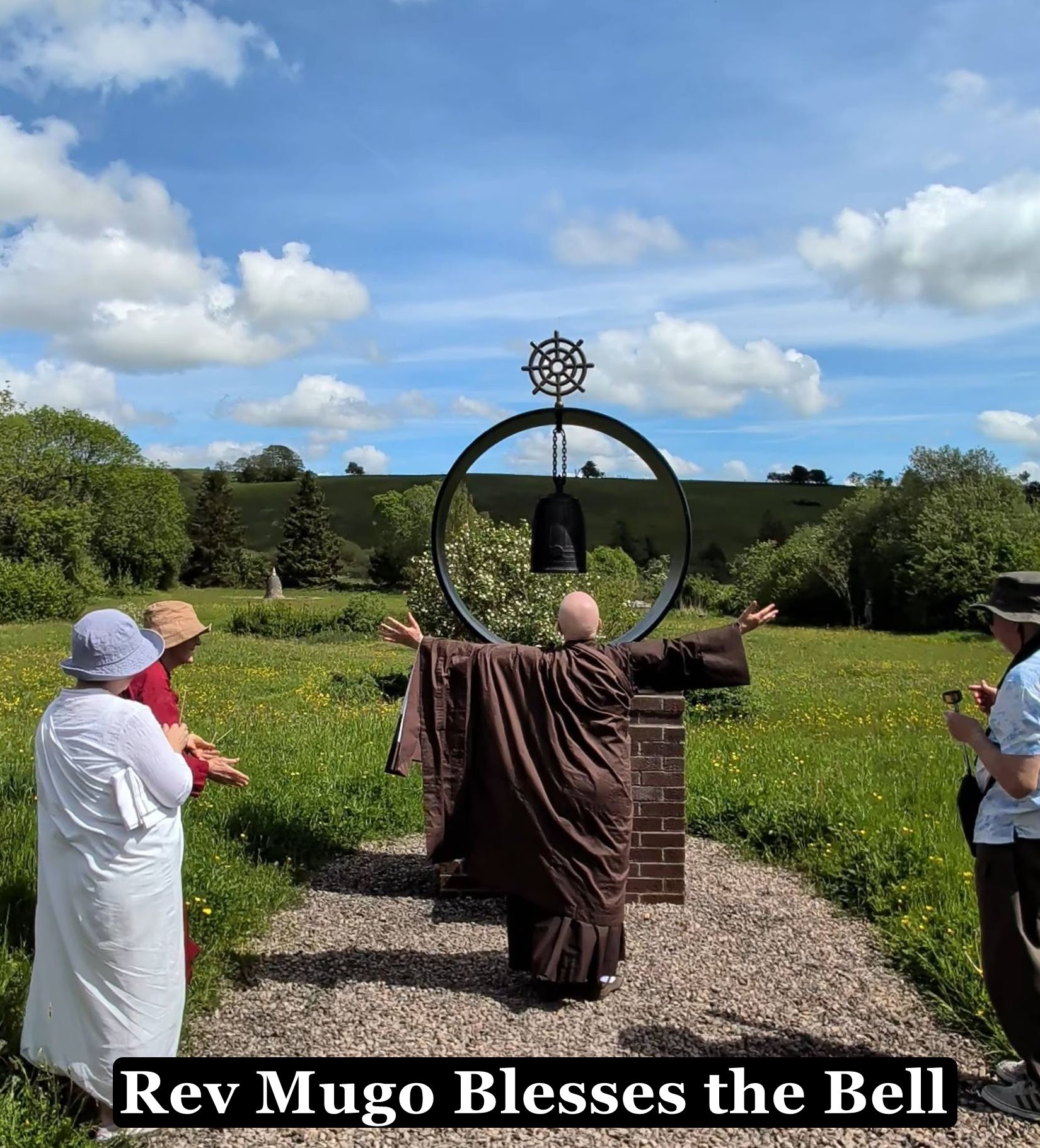
Noirin here. Happily the recent spell of good weather included Buddha Day, which we celebrated last Saturday. Bhante had invited Rev Mugo from the Zen Priory in Telford to bless the 'new' Zen bell which followed him back to Satipanya after his pilgrimage to Japan nine years ago.

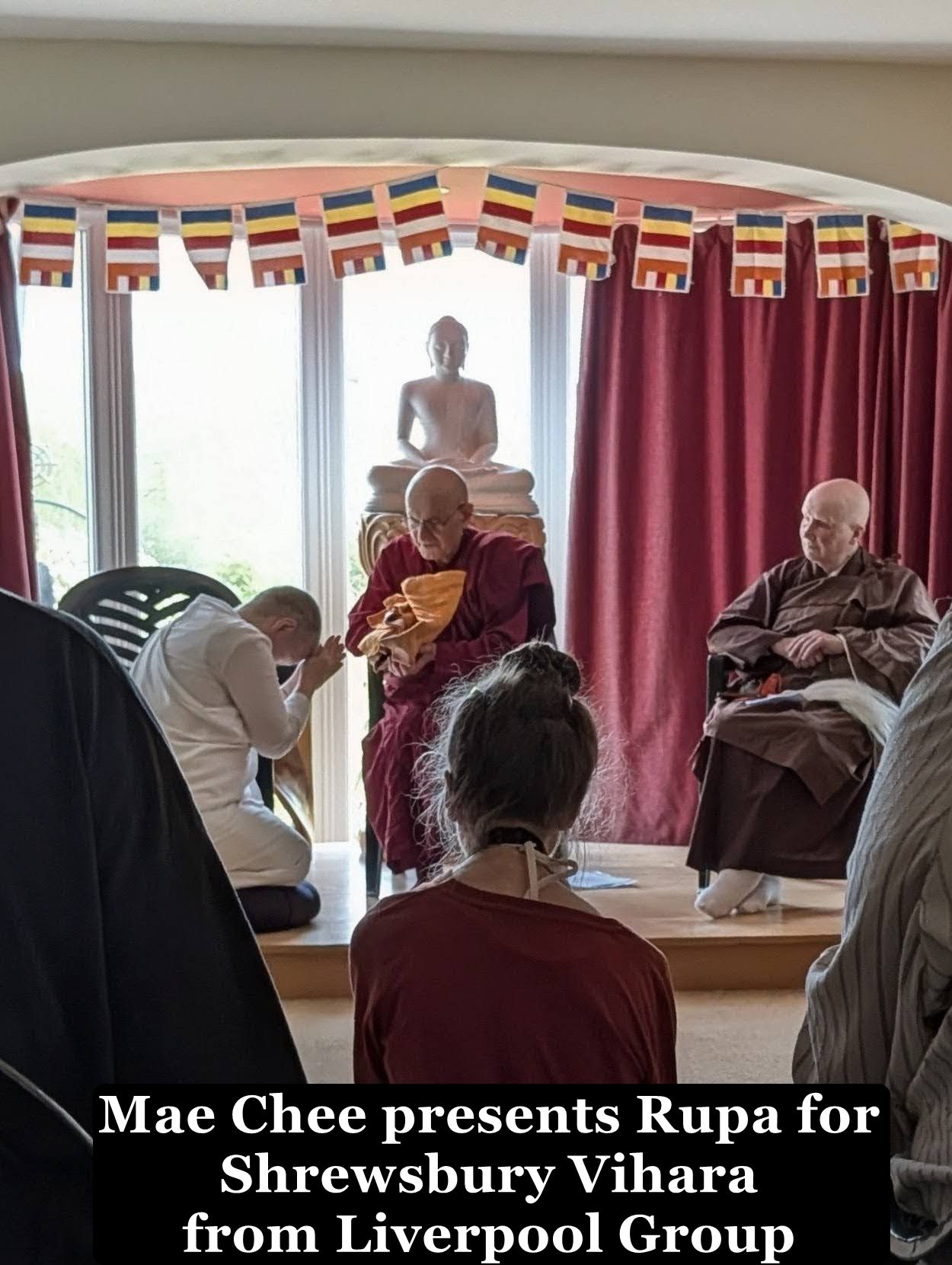
We were delighted that Mae Chee (also known as Sister Rachel-Anne) came along with several members of the Liverpool Theravada group. On their behalf she presented Bhante with a rupa for the new Shrewsbury Vihara where he is now living. 

Bhante, Mae Chee and Rev Mugo gave inspiring talks to open the ceremony, which I have done my best to summarise in the this month's tip below.  
                                            

In other news - our offer for The Homestead has been accepted with the aid of some generous loans which are tiding us over until we can sell Sativasa (our personal retreat house in Bishops Castle).  A survey will be carried out next week and if all goes to plan, we hope Jim and Maureen can move in there later in the summer to let Jim take up his new role as Satipanya Manager.

Announcements

Daily Life Course: This years on-line course is titled "Rooted in Mud" and looks at the many ways our path to liberation can spring from the mud and mire of deep sorrows as well as the minor miseries of everyday life. The course includes suggested exercises for home practice and the opportunity to share your reflections with other students on the Satipanya Forum. The first run of the 7 week course started mid-May and it  will run again in October. For further information or to register please contact Noirin. 

Personal Retreat: Our house in Bishops Castle "Sativasa" remains open for personal retreats. Suitable only for those with a well-established meditation practice. Come for a week or longer. Retreats are self catering so the first day might need to be spent shopping, cooking etc. See here for more info. To apply email Bhante or Noirin.

Sharing the Path, Satipattthana Studies Part 1 has been published as an ebook, kindle, paperback and can be dowloaded as a PDF. Based on Noirin's Daily Life courses over previous years and supplemented by students' reflections, the book offers a study-practice guide to the Buddha's teaching on Mindfulness of Body, Feeling and Mind. Many thanks to Therese Caherty for editing. Further info here.

Meeting in London: Satipanya London Sangha is a small but growing community of friendly and supportive meditators meeting in person at a peaceful community garden near King's Cross station for group sits and lighthearted discussions.

If you'd like to attend upcoming meetings in London and practice vipassana in the tradition of Mahasi Sayadaw then email Maz and ask to be added to the mailing list.

Regular Online Meetings:

Meditation Hall on Zoom: Join us for your daily meditation -  Info.

Satipanya Spiritual Companions: An informal meditation group meets on a monthly basis via Zoom for a full day of meditation. Email Magda for details at [email protected]

Online Study Group: 
This collaborative online group studies various dhamma topics across multiple traditions — so, not just Mahāsi practice. Carl says: We warmly extend an invitation to any practitioner who would like to join us. Currently meeting on the second and fourth Sundays of each month at 10:20am - around midday. Please contact Carl at [email protected] for further information.

Full Moon Celebrations: Join 20.00 to 21.00 on the Sunday closest to the Full Moon. Bhante gives a short dhamma talk, followed by a 30-min sitting, refuges and precepts and we end by reading and chanting the metta sutta.  For date of next Celebration.   
 
Opening to the Impact of the Climate Emergency:  Following on from the Zoom with Gwen Sanderson and Bhante Bodhidhamma in 2023, there are two options for ongoing engagement:
  • Gwen Sanderson is facilitating monthly Climate and Dhamma Conversations which are held using Zoom. Email Gwen for further information or to register. 
  • Noirin Sheahan has set up a Satipanya Forum focussing on the Six Maxims (ethical training to prepare for the social and environmental consequences of climate change). Contact Noirin for further info or to register.  

Karuna Book: Every morning at puja we call the names of those who are sick or dying, or are having a hard time.

Mudita Book: Every evening at puja we call the names of those who have something to rejoice.

Satipanya Courses

Vipassana as taught by the Mahasi Sayadaw of Burma

The Mahasi Sayadaw of Burma, one of the most influential vipassana insight meditation teachers of the last century, developed techniques to help us maintain moment to moment mindfulness from the instant we awake to the instant we fall asleep.

This leads not only to spiritual insights into our true, unborn-undying essence, but also, equally important, to the purification of the heart. So that we not only become wiser but more caring, generous, joyous and compassionate.

Applying the techniques on this retreat we follow a robust schedule, but meditators can modulate their practice to fit their level of experience, even absolute beginners. The accent is on relaxation and curiosity, rather than striving and concentration. And regular teacher contact, daily Q&A and personal interviews ensures students are supported throughout.

The retreat ends with advice on how to bring the practice into ordinary daily life to enhance our relationships and give spiritual meaning to our work and everyday tasks.

Assistants Needed

N.B. All the courses are serviced by assistants.

As assistant you have the opportunity to serve others. It can be a way of expressing gratitude for the gift of Dhamma. Although the morning is mainly taken up with breakfast preparation and cooking, the rest of day is for practice.

You can see the menus here (PDF).

As an assistant, we do not expect payment of the deposit or make a donation because you have kindly offered your time.

However, your commitment is essential, for the course would be very difficult to run without an assistant and may indeed have to be cancelled.

If you are interested, follow this link: Course Assistant

For info. about retreats and teachers see website: www.satipanya.org.uk
See drop down menus: especially About Us, Teachings and Retreats

Would you like to come and assist on a course?

See calendar on website for up-to-date assistant need.

Satipanya Calendar 2026


Please apply only when you are certain to come.

Awakening, Heart, and Ground:
A Buddha Day Reflection


Noirin Sheahan

At last weekend's Buddha Day celebration, we heard three talks that brought us from the Buddha’s Awakening through the qualities of the heart that sustain our path and the Buddha nature that is our deepest ground.
 
Bhante began with the Tevijja — the three knowledges that came to the Buddha on the night of his awakening. In the first watch he understood dependent arising as it applied to himself, recollecting his many past lives with their features and details. Ignorance was destroyed and knowledge arose; darkness was destroyed and light arose, as happens for a meditator who is diligent, keen, and resolute. But even such pleasant feeling did not occupy my awareness.
 
In the second watch he saw how dependent arising applied to all beings: I saw sentient beings passing away and being reborn — inferior and superior, beautiful and ugly, in a good place or a bad place. I understood how sentient beings are reborn according to their deeds.
 
In the third watch he saw how all suffering comes to an end through the cessation of the three defilements: the desire for sense pleasure, desire for rebirth, and ignorance — which Bhante explained as the mistake of identifying with our body and mind. Knowing and seeing like this, my mind was freed from the defilements of sensuality, desire to be reborn, and ignorance. When it was freed, I knew it was freed. Rebirth is ended; the spiritual journey has been completed; what had to be done has been done; there is no return to any state of becoming.

Bhante closed by inviting us to ponder some of the ways Nibbāna is described —  although these can only point at what words can’t reach: unconditioned (beyond cause and effect); peaceful; blissful; ineffable (beyond concept, indescribable); radiant (dispelling darkness and ignorance, illuminating in pure awareness).
 
Where Bhante had taken the Buddha's Awakening to the edge of the knowable, Mae Chee turned to the qualities of the Buddha that we can know - the Brahma Vihārās, the Divine Abodes. These states of mind and heart accompany and sustain our own path toward awakening.
 
She offered a memorable image: a flowering plant, rooted in the earth.

Equanimity, she said, is the root system — the foundation of everything. It doesn't reach toward the light but it holds firm. Accepting situations just as they are, equanimity steadies and anchors the mind however hard the winds of desire or aversion may blow. Without it, the whole plant topples.
 
Mettā — goodwill — is the stem, holding the plant upright and directing it toward the light. Likewise mettā orients our whole being toward liberation, lifts us from the mud of dukkha.  Like sap rising through the stem to nourish every part, goodwill is the living essence flowing through every expression of the awakened heart.

And then the flowers: karuna (compassion) and muditā (appreciative joy). These don't bloom continuously — they arise when conditions call them forth. When we encounter suffering, compassion opens; we are able to empathise, to sit alongside another in their difficulty without flinching or turning away.
 
When we meet with happiness — our own or another's — muditā blooms: an inner gladness that mirrors outer joy, a grateful recognition of goodness wherever it appears.

Both Compassion and Mudita are expressions of the same mettā that flows beneath them, shaped by circumstance into their particular form. All are supported by the steadying root of equanimity. 
 
Rev. Mugo thanked the other two for giving her, she said, a perfect opening.  She spoke of her own name: mu, signifying emptiness, and go, signifying awakening — pointing to the empty, luminous nature of mind that is our Buddha nature. Everything that had been said, she suggested, was in some sense a description of this: the awakening the Buddha touched, the qualities of heart that open toward it, all pointing to something that is already here, already our deepest nature, even before we have recognised it as such.
 
She stressed that Buddha mind is not something we acquire or construct. It is our natural state — always present, waiting to be noticed in the gap before experience gets named and sorted.

She asked us: what is the smallest unit of time? And then pointed us toward an example: that gap just before we strike the bell (for each of us would sound it as part of the blessing ceremony). In that tiny pause before the sound is heard, we can taste the undefinable, unconditioned nature of what is our deepest truth.
 
She then explained how she would bless the bell using water and a palm frond - symbols of new life and purity.  She invited us to hear the bell as the voice of the Buddha, calling us to be present and to seek our true nature. What a beautiful image. Since the weekend, the sound of the bell makes me stop in my tracks.
 
Bhante had mentioned that the bell was now nine years old, and Rev. Mugo noted that Bodhidharma had spent nine years facing the wall — entirely fitting that the bell had also waited nine years before receiving its blessing!
 
Rev. Mugo said more, but I can't recall her words now — perhaps because she ended by asking us to let go of everything she had said, not to hold onto any of it. My mind was obviously in an obedient mood.
 
I'm grateful to Bhante, Mae Chee, and Rev. Mugo for their inspiring talks. These are my notes and impressions rather than a transcript — I hope they capture something true, even where memory has filled in the gaps.
 

If you fail to receive a monthly NEWSBYTE, please look in spam, or reestablish the email by filling in the MAILING LIST form at the bottom of the front page of the website.

Many thanks.

Finally, please forward this email if you know someone who may be interested. Thanks.

Metta
Onward
Bodhidhamma

SATIPANYA  BUDDHIST TRUST
www.satipanya.org.uk
Directors Jim Tibby  Richard Benjamin  Noirin Sheahan  Mike Regan  Gwen Sanderson
Limited Company Number 05924965 Registered Charity Number 1116668
Satipanya Buddhist Trust Satipanya White Gritt, Minsterley Shrewsbury, Shropshire SY5 0JN United Kingdom
T: +44 (0)1588 650752
info: [email protected]

MAY NEWSBYTE 2026
 

Trust all is well!

People keep disappearing from the mailing list. We have realised this happens when an existing subscriber applies for a retreat and selects the checkbox to subscribe to the Newsbyte. If this happens to you, and you realise you haven't received a Newsbyte, please email us here and we'll fix your subscription.


All Past Tips


For calendar and assistant opportunities, see below.

Tip o' the Day


Rooted in Mud
An Introduction to the coming on-line Daily Life Course
Noirin Sheahan

(Difficulty reading text? Press Ctrl +)

Diary

Noirin here. We have now completed the first month of the spring-summer retreat and Bhante's first fortnight as a 'visiting teacher'!  He says he is slowly finding his feet in his new life in the Shrewsbury Vihara. 

Things have changed again in our plans to house the new manager (Jim Tibby). Another nearby house, "The Homestead"  came up for sale in April. The Trust found it a much better buy than Poplar Cottage. It is being offered at a lower price, and is a recent build (1975) whereas Poplar Cottage is about 200 years old. Although its antiquity gives charm it also gives challenges for maintenance. And the close proximity of the big agricultural shed belonging to the farmers next door means an ongoing invasion of rodents - the survey had found evidence of recent activity in the loft and around the grounds.  

The Homestead is just 20 mins walk from Satipanya, it's by the post-box for those of you who know the area. The house is small (two bedrooms) but well-built and bright, with a lovely garden surrounded by old meadows which the previous owners have maintained for decades and which were last year taken over by a community land trust which will maintain them as wildflower meadows.  

We have now put our offer for Poplar Cottage on hold and have made an offer for The Homestead, which has been accepted, subject to us being able to show proof of purchase with 6-8 weeks. This is difficult as the financial uncertainty associated with the war in the Middle East has stalled the housing market in Bishops Castle. Thus we are busy pursuing mortgages, loans and donations to try to make up the required sum within this deadline. 

If you can afford to make a donation it will be especially appreciated at this time. See the Treasurer's Report for more information. 

Announcements

Daily Life Course: This years on-line course is titled "Rooted in Mud" and looks at the many ways our path to liberation can spring from the mud and mire of deep sorrows as well as the minor miseries of everyday life. The course includes suggested exercises for home practice and the opportunity to share your reflections with other students on the Satipanya Forum. It runs for 7 weeks starting mid-May and will run again in October. For further information or to register please contact Noirin. 

Personal Retreat: Our house in Bishops Castle "Sativasa" remains open for personal retreats. Suitable only for those with a well-established meditation practice. Come for a week or longer. Retreats are self catering so the first day might need to be spent shopping, cooking etc. See here for more info. To apply email Bhante or Noirin.

Sharing the Path, Satipattthana Studies Part 1 has been published as an ebook, kindle, paperback and can be dowloaded as a PDF. Based on Noirin's Daily Life courses over previous years and supplemented by students' reflections, the book offers a study-practice guide to the Buddha's teaching on Mindfulness of Body, Feeling and Mind. Many thanks to Therese Caherty for editing. Further info here.

Meeting in London: Satipanya London Sangha is a growing community of friendly and supportive meditators meeting in-person every month in a peaceful community garden near King's Cross station for group sits and lighthearted discussions.

If you'd like to attend upcoming meetings in London and practice vipassana in the tradition of Mahasi Sayadaw then join our WhatsApp group using this link and say hello, or email Maz if you have any questions. 

Regular Online Meetings:

Meditation Hall on Zoom: Join us for your daily meditation -  Info.

Satipanya Spiritual Companions: An informal meditation group meets on a monthly basis via Zoom for a full day of meditation. Email Magda for details at [email protected]

Online Study Group: 
This collaborative online group studies various dhamma topics across multiple traditions — so, not just Mahāsi practice. Carl says: We warmly extend an invitation to any practitioner who would like to join us. Currently meeting on the second and fourth Sundays of each month at 10:20am - around midday. Please contact Carl at [email protected] for further information.

Full Moon Celebrations: Join 20.00 to 21.00 on the Sunday closest to the Full Moon. Bhante gives a short dhamma talk, followed by a 30-min sitting, refuges and precepts and we end by reading and chanting the metta sutta.  For date of next Celebration.   
 
Opening to the Impact of the Climate Emergency:  Following on from the Zoom with Gwen Sanderson and Bhante Bodhidhamma in 2023, there are two options for ongoing engagement:
  • Gwen Sanderson is facilitating monthly Climate and Dhamma Conversations which are held using Zoom. Email Gwen for further information or to register. 
  • Noirin Sheahan has set up a Satipanya Forum focussing on the Six Maxims (ethical training to prepare for the social and environmental consequences of climate change). Contact Noirin for further info or to register.  

Karuna Book: Every morning at puja we call the names of those who are sick or dying, or are having a hard time.

Mudita Book: Every evening at puja we call the names of those who have something to rejoice.

Satipanya Courses

Vipassana as taught by the Mahasi Sayadaw of Burma

The Mahasi Sayadaw of Burma, one of the most influential vipassana insight meditation teachers of the last century, developed techniques to help us maintain moment to moment mindfulness from the instant we awake to the instant we fall asleep.

This leads not only to spiritual insights into our true, unborn-undying essence, but also, equally important, to the purification of the heart. So that we not only become wiser but more caring, generous, joyous and compassionate.

Applying the techniques on this retreat we follow a robust schedule, but meditators can modulate their practice to fit their level of experience, even absolute beginners. The accent is on relaxation and curiosity, rather than striving and concentration. And regular teacher contact, daily Q&A and personal interviews ensures students are supported throughout.

The retreat ends with advice on how to bring the practice into ordinary daily life to enhance our relationships and give spiritual meaning to our work and everyday tasks.

Assistants Needed

N.B. All the courses are serviced by assistants.

As assistant you have the opportunity to serve others. It can be a way of expressing gratitude for the gift of Dhamma. Although the morning is mainly taken up with breakfast preparation and cooking, the rest of day is for practice.

You can see the menus here (PDF).

As an assistant, we do not expect payment of the deposit or make a donation because you have kindly offered your time.

However, your commitment is essential, for the course would be very difficult to run without an assistant and may indeed have to be cancelled.

If you are interested, follow this link: Course Assistant

For info. about retreats and teachers see website: www.satipanya.org.uk
See drop down menus: especially About Us, Teachings and Retreats

Would you like to come and assist on a course?

See calendar on website for up-to-date assistant need.

Satipanya Calendar 2026


Please apply only when you are certain to come.

Rooted in Mud
An introduction to this year's On-line Daily Life Course

Noirin Sheahan

In his book No Mud, No Lotus Thích Nhất Hạnh says:  Most people are afraid of suffering. But suffering is a kind of mud to help the lotus flower of happiness grow. There can be no lotus flower without mud.

This echoes the Upanisa Sutta, a lesser-known variation on the teaching of Dependent Arising. Many of you will be familiar with the 12-step formula for Dependent Arising, which describes a cause-and-effect chain whereby we unwittingly cause dukkha / suffering / unsatisfactoriness (final step) because of not understanding what causes dukkha (first step). Ironic isn’t it …

The Upanisa Sutta describes a further 12-step cause and effect process which starts with dukkha and ends with the knowledge of liberation. Suffering (dukkha) is the root cause of our liberation.

This is indeed an uplifting perspective on dukkha. There are other suttas which say much the same thing. Together they are known as the Spiral Teachings. They all describe an identical cause-and-effect process leading, like a spiral staircase, to liberation.

Interestingly they sometimes provide different entry points to the spiral and these differences provide the focus for this year’s course. Next year’s course will explore the later links in the spiral, but first we have the more pressing need to find ways of extracting ourselves from the mud so as to glimpse the light of freedom and orient ourselves in that direction.

It is refreshing to know that there are many ways to do this. In the opening lines of Anna Karenina, Tolstoy says: All happy families are alike; each unhappy family is unhappy in its own way. In the mud of dukkha we become more individualized, go to our own extremes. What works to get me out of the mud might infuriate you, make you dig in deeper. 

For me (today) it might be to withdraw from life with all its temptations and busyness, find a quiet spot to let myself cool off and heal. For you (today) it might be to launch yourself into some form of useful activity, busy yourself by taking good care of what matters. Tomorrow we could both be different – I might need to think of some inspiring ideal to prize myself from the mud; you might find your way out by investigating root causes.

The Spiral Teachings suggest seven different ‘entry points’ to the spiral: Faith / Confidence / Trust, Wise Investigation, Ethical Action, Restraint, Dedication & Care, Full Awareness, Inspiration. The course will suggest ways of developing all of these in ordinary daily life as well as in formal meditation. Thus when we are shocked by bad news, depressed at our failings or in whatever way knocked about by life, we will have seven possible ways to let this particular lump of mud nourish our path to liberation.

The notes and exercises are inspired by a Tricycle on-line course I attended a few years ago titled: The Spiral to Freedom, taught by John Peacock and Akincano Weber.  They contend that the links in the spiral can be seen in everyday life, which I found to be true. It can be a challenge to see them in vipassana where our main job is to learn how to stop causing suffering. The Spiral Teachings help us acknowledge and appreciate moments where suffering is not being caused. It can be easier to see these in the arena of everyday life where broad awareness gives a different perspective to the more intense, fine focus developed in vipassana.

Experiencing and acknowledging moments when we’re not causing dukkha strengthens confidence in our ability to find the path to freedom. It also lessens the fear of making mistakes, causing dukkha unwittingly – which we’re bound to do till we’re fully liberated. It doesn’t matter so much that we keep burying ourselves up to the neck in mud when we know that the path to freedom is buried alongside us in the mud.

For more information or to register for the course contact me here: Noirin

If you fail to receive a monthly NEWSBYTE, please look in spam, or reestablish the email by filling in the MAILING LIST form at the bottom of the front page of the website.

Many thanks.

Finally, please forward this email if you know someone who may be interested. Thanks.

Metta
Onward
Bodhidhamma

SATIPANYA  BUDDHIST TRUST
www.satipanya.org.uk
Directors Jim Tibby  Richard Benjamin  Noirin Sheahan  Mike Regan  Gwen Sanderson
Limited Company Number 05924965 Registered Charity Number 1116668
Satipanya Buddhist Trust Satipanya White Gritt, Minsterley Shrewsbury, Shropshire SY5 0JN United Kingdom
T: +44 (0)1588 650752
info: [email protected]

APRIL NEWSBYTE 2026
 

Trust all is well!

Frustratingly, people keep disappearing from the mailing list. We have realised this happens when an existing subscriber applies for a retreat and selects the checkbox to subscribe to the Newsbyte. If this happens to you, and you realise you haven't received a Newsbyte, please email us here and we'll fix your subscription.


All Past Tips


For calendar and assistant opportunities, see below.

Tip o' the Day


The Treasurer's Annual Report below.

(Difficulty reading text? Press Ctrl +)

Diary
Diary follows the Treasurer's report and has news about the Shrewsbury Vihara (including photos), the new manager, and Ayya Anopama.


Treasurers report 2026

 The news from last year was that, in the July following my April Report, we were able to buy a bungalow in Shrewsbury for Bhante’s retirement. As seems to be the usual case, it took until 3rd March this year for Bhante to actually start living there. There was not that much work to be done on the property, but getting the trades people took a long time, and they often took their time. The electrician, although his work was excellent, took four months to do a week’s work!

The ‘Shrewsbury Vihara’ is also a place people can come and meet. The front room is a dedicated meditation room. It yet needs a shrine and a statue. Bhante hopes to have a blessing of the property within the next three months.

This year, to our great good fortune, another bungalow, not a minute’s walk away from Satipanya retreat centre, has come up for sale. The owners, Clare and Peter, have done a really good renovating job and smartening up of the house and garden and even installed PV Cells. The cost is £375K which is the sort of price you pay for bungalows in this area. White Grit is a well-to-do retirement village.


A New Appeal

Needless to say we wish to buy this property. It will be perfect for future managers of the retreat centre to live close by, and as such we are selling the property we bought in Bishops Castle, a semi-detached for which we are asking £295K. You will notice that this falls short of the money we need to buy the bungalow. We have got some of the money needed, but we may be short by just over £50k. So this is our new appeal. Any amount you can offer, no matter how small, will help us to buy the property, decreasing the amount we may have to take out as a loan.

The final bit of good news is that we have a manager. Jim Tibby, who is the Chair of the Trust and whom many of you will have met as the assistant and occasional gardener, will come with his wife, Maureen, to live in the new property and take care of the running of our treasured Satipanya.

So, it is all good news in a world on fire!


Many thanks, again, to all who donate at the retreats and all those who donate in support of the centre. The finances will be made public on Companies House and the 
Charity Commission website soon.

As always, a request for you to consider a regular donation if you have not given one before. And if you are already giving, a small addition would be gratefully received, especially now when we are hoping to buy Poplar Cottage and we may need as much as £50+K.

You can donate single and continuing gifts via PayPal:

http://www.satipanya.org.uk/donations/


£1.00 a week is a worthy gift!

However, if you prefer to offer by way of Internet Banking the details are below.
 
(Don’t forget to click on Gift Aid if you have a given us a form or wish to have your donation Gift Aided. You can download the form from the Donation page and email it. No need to sign.)
 
Metta
R1
Richard Benjamin
Treasurer on behalf of the Trustees.


Diary
Noirin here. In early March, Bhante moved out of Satipanya. and is now living in the vihara in Shrewsbury - see photos below.  A big change for Satipanya as well as Bhante, but so far so good. Bhante is settling in well to his new home, and hosted the Trust AGM there last Sunday. We got a lot of business done – Bhante's Builder's tea helped us through!

I am sure I speak for all of you in wishing Bhante much happiness in his new home and retirement from the leadership role he has played for Satipanya. 

We issued a call for a Manager in January and are very happy to announce that Jim Tibby will take up the role. Jim has been involved with Satipanya for over a decade. He serves as Chairman to the Trust and regularly comes to assist retreats as well as to help with gardening jobs and tending the pond. Thus he is already an integral part of Satipanya and I very much look forward to handing over the management duties to him over the next two years.

Again, I'm sure I speak for all of you in welcoming Jim to the role and wishing him much benefit and joy from it. 

Good news – our bid for Poplar Cottage – next door to Satipanya has been accepted. This is an ideal location for the new manager. To finance the purchase, Sativasa (our house in Bishops Castle) is now on the market and gets its first viewing this weekend. Sativasa's sale won't cover the full cost of the cottage and we are issuing a special appeal to bridge the gap - see Treasurer's Report above.

Until it is sold, Sativasa can still be used for personal retreats. Early in March we were happy to invite Ayya Anopama to stay for a 6-week retreat. Ayya ordained with Venerable Pa Auk Sayadaw and has practiced in the Mahasi tradition with several teachers including Sayadaw U Tejaniya from Burma and Joseph Goldstein. She teaches meditation at Gaia House and many other centres in Europe and America. I'm happy to say she has fallen in love with Sativasa and would love to stay there forever! 

All is set for the opening of the Spring / Summer retreat this weekend, many thanks to all who offered help with spring cleaning.

The Shrewsbury Vihara

Shrine Room to be

Shrine Room to be

Front Garden

Back Garden

Bhante's Study

Announcements

Personal Retreat: Our house in Bishops Castle "Sativasa" remains open for personal retreats. Suitable only for established meditators. Come for a week or longer. Retreats are self catering so the first day might need to be spent shopping, cooking etc. See here for more info. To apply email Bhante or Noirin.

Sharing the Path, Satipattthana Studies Part 1 has been published as an ebook, kindle, paperback and can be dowloaded as a PDF. Based on Noirin's Daily Life courses over previous years and supplemented by students' reflections, the book offers a study-practice guide to the Buddha's teaching on Mindfulness of Body, Feeling and Mind. Many thanks to Therese Caherty for editing. Further info here.

Meeting in London: Satipanya London Sangha is a growing community of friendly and supportive meditators meeting in-person every month in a peaceful community garden near King's Cross station for group sits and lighthearted discussions.

If you'd like to attend upcoming meetings in London and practice vipassana in the tradition of Mahasi Sayadaw then join our WhatsApp group using this link and say hello, or email Maz if you have any questions. 

Regular Online Meetings:

Meditation Hall on Zoom: Join us for your daily meditation -  Info.

Satipanya Spiritual Companions: An informal meditation group meets on a monthly basis via Zoom for a full day of meditation. Email Magda for details at [email protected]

Online Study Group: 
This collaborative online group studies various dhamma topics across multiple traditions — so, not just Mahāsi practice. Carl says: We warmly extend an invitation to any practitioner who would like to join us. Currently meeting on the second and fourth Sundays of each month at 10:20am - around midday. Please contact Carl at [email protected] for further information.

Full Moon Celebrations: Join 20.00 to 21.00 on the Sunday closest to the Full Moon. Bhante gives a short dhamma talk, followed by a 30-min sitting, refuges and precepts and we end by reading and chanting the metta sutta.  For date of next Celebration.   
 
Opening to the Impact of the Climate Emergency:  Following on from the Zoom with Gwen Sanderson and Bhante Bodhidhamma in 2023, there are two options for ongoing engagement:
  • Gwen Sanderson is facilitating monthly Climate and Dhamma Conversations which are held using Zoom. Email Gwen for further information or to register. 
  • Noirin Sheahan has set up a Satipanya Forum focussing on the Six Maxims (ethical training to prepare for the social and environmental consequences of climate change). Contact Noirin for further info or to register.  

Karuna Book: Every morning at puja we call the names of those who are sick or dying, or are having a hard time.

Mudita Book: Every evening at puja we call the names of those who have something to rejoice.

Satipanya Courses

Vipassana as taught by the Mahasi Sayadaw of Burma

The Mahasi Sayadaw of Burma, one of the most influential vipassana insight meditation teachers of the last century, developed techniques to help us maintain moment to moment mindfulness from the instant we awake to the instant we fall asleep.

This leads not only to spiritual insights into our true, unborn-undying essence, but also, equally important, to the purification of the heart. So that we not only become wiser but more caring, generous, joyous and compassionate.

Applying the techniques on this retreat we follow a robust schedule, but meditators can modulate their practice to fit their level of experience, even absolute beginners. The accent is on relaxation and curiosity, rather than striving and concentration. And regular teacher contact, daily Q&A and personal interviews ensures students are supported throughout.

The retreat ends with advice on how to bring the practice into ordinary daily life to enhance our relationships and give spiritual meaning to our work and everyday tasks.

Assistants Needed

N.B. All the courses are serviced by assistants.

As assistant you have the opportunity to serve others. It can be a way of expressing gratitude for the gift of Dhamma. Although the morning is mainly taken up with breakfast preparation and cooking, the rest of day is for practice.

You can see the menus here (PDF).

As an assistant, we do not expect payment of the deposit or make a donation because you have kindly offered your time.

However, your commitment is essential, for the course would be very difficult to run without an assistant and may indeed have to be cancelled.

If you are interested, follow this link: Course Assistant

For info. about retreats and teachers see website: www.satipanya.org.uk
See drop down menus: especially About Us, Teachings and Retreats

Would you like to come and assist on a course?

See calendar on website for up-to-date assistant need.

Satipanya Calendar 2026


Please apply only when you are certain to come.

If you fail to receive a monthly NEWSBYTE, please look in spam, or reestablish the email by filling in the MAILING LIST form at the bottom of the front page of the website.

Many thanks.

Finally, please forward this email if you know someone who may be interested. Thanks.

Metta
Onward
Bodhidhamma

SATIPANYA  BUDDHIST TRUST
www.satipanya.org.uk
Directors Jim Tibby  Richard Benjamin  Noirin Sheahan  Mike Regan  Gwen Sanderson
Limited Company Number 05924965 Registered Charity Number 1116668
Satipanya Buddhist Trust Satipanya White Gritt, Minsterley Shrewsbury, Shropshire SY5 0JN United Kingdom
T: +44 (0)1588 650752
info: [email protected]

MARCH NEWSBYTE 2026
 

Trust all is well!

Worryingly, people keep disappearing from the mailing list. We don't know why.
If you realise you haven't received a Newsbyte, please rejoin the Mailing List at the bottom of the front page.


All Past Tips


For calendar and assistant opportunities, see below.

Tip o' the Day


 Polarisation  
A Disease of Conceit
Sorry! Another long read.
Bhante Bodhidhamma
See Below.

(Difficulty reading text? Press Ctrl +)

Calendar 2026 is open for Applications

Practice in Daily Life (PODL)
Online support for Practice, Jan - March,
Led by Bhante,  Info here


Full Moon Celebration  March 08

Diary

We have had some good luck! The cottage next door to Satipanya has come up for sale - the perfect location for the new manager. 

Most houses in our area are far too expensive for us to consider (that's why we had purchased a house in Bishops Castle for the manager), but luckily the house next door, originally a  miner's cottage, is within our range. 

It does mean selling the house in Bishops Castle, and an appeal to cover the extra cost. More about that in the Treasurer's Newsbyte in April. 

In the meantime, I continue my move to Shrewsbury and hope to pass my first night there on the Full Moon of March, this coming Wednesday. I've always been a little superstitious and this is a very auspicious day!  --
 

Announcements

Personal Retreat:  Our house in Bishops Castle "Sativasa" remains open for personal retreats. Suitable only for established meditators. Come for a week or longer. Retreats are self catering so the first day might need to be spent shopping, cooking etc. See here for more info. To apply email Bhante or Noirin .

Sharing the Path, Satipattthana Studies Part 1  has been published as an ebook , kindle , paperback and can be dowloaded as a PDF . Based on Noirin's Daily Life courses over previous years and supplemented by students' reflections, the book offers a study-practice guide to the Buddha's teaching on Mindfulness of Body, Feeling and Mind. Many thanks to Therese Caherty for editing. Further info here .

Meeting in London:   Satipanya London Sangha is a growing community of friendly and supportive meditators meeting in-person every month in a peaceful community garden near King's Cross station for group sits and lighthearted discussions.

If you'd like to attend upcoming meetings in London and practice vipassana in the tradition of Mahasi Sayadaw then join our WhatsApp group using  this link  and say hello, or  email Maz  if you have any questions.  

Regular Online Meetings:

Meditation Hall on Zoom:  Join us for your daily meditation -   Info.

Satipanya Spiritual Companions:  An informal meditation group meets on a monthly basis via Zoom for a full day of meditation. Email Magda for details at  [email protected]

Online Study Group: 
This collaborative online group studies various  dhamma topics across multiple traditions — so, not just Mahāsi practice. Carl says: We warmly extend an invitation to any practitioner who would like to join us. Currently meeting on the second and fourth Sundays of each month at 10:20am - around midday. Please contact Carl at  [email protected] for further information.

Full Moon Celebrations:  Join 20.00 to 21.00 on the Sunday closest to the Full Moon. Bhante gives a short dhamma talk, followed by a 30-min sitting, refuges and precepts and we end by reading and chanting the metta sutta.  For date of next Celebration.   
 
Opening to the Impact of the Climate Emergency:   Following on from the Zoom with Gwen Sanderson and Bhante Bodhidhamma in 2023, there are two options for ongoing engagement:
  • Gwen Sanderson is facilitating monthly Climate and Dhamma Conversations which are held using Zoom . Email Gwen for further information or to register. 
  • Noirin Sheahan has set up a Satipanya Forum focussing on the Six Maxims (ethical training to prepare for the social and environmental consequences of climate change). Contact Noirin for further info or to register.  

Karuna Book: Every morning at puja we call the names of those who are sick or dying, or are having a hard time.

Mudita Book: Every evening at puja we call the names of those who have something to rejoice.

Satipanya Courses

Vipassana as taught by the Mahasi Sayadaw of Burma

The Mahasi Sayadaw of Burma, one of the most influential vipassana insight meditation teachers of the last century, developed techniques to help us maintain moment to moment mindfulness from the instant we awake to the instant we fall asleep.

This leads not only to spiritual insights into our true, unborn-undying essence, but also, equally important, to the purification of the heart. So that we not only become wiser but more caring, generous, joyous and compassionate.

Applying the techniques on this retreat we follow a robust schedule, but meditators can modulate their practice to fit their level of experience, even absolute beginners. The accent is on relaxation and curiosity, rather than striving and concentration. And regular teacher contact, daily Q&A and personal interviews ensures students are supported throughout.

The retreat ends with advice on how to bring the practice into ordinary daily life to enhance our relationships and give spiritual meaning to our work and everyday tasks.

Assistants Needed

N.B. All the courses are serviced by assistants.

As assistant you have the opportunity to serve others. It can be a way of expressing gratitude for the gift of Dhamma. Although the morning is mainly taken up with breakfast preparation and cooking, the rest of day is for practice.

You can see the menus here (PDF).

As an assistant, we do not expect payment of the deposit or make a donation because you have kindly offered your time.

However, your commitment is essential, for the course would be very difficult to run without an assistant and may indeed have to be cancelled.

If you are interested, follow this link: Course Assistant

For info. about retreats and teachers see website: www.satipanya.org.uk
See drop down menus: especially About Us, Teachings and Retreats

Would you like to come and assist on a course?

See calendar on website for up-to-date assistant need.

Satipanya Calendar 2026

The 2026 Calanders is available for courses into January.
Please Note

Courses from late March into late summer open for application on
Friday, 16 January
Please apply only when you are certain to come.

Polarisation

Bhante Bodhidhamma

Polarisation is now widespread in democracies both in Europe and in the Americas. It manifests the deep dissatisfaction many people now feel about the society they live in. It centres around such areas as woke, immigration, job security and income inequality. I have made use of ChatGPT and YouTube to get a broad picture of what is happening. I shall go through what I have gleaned, what the solutions might be and look at the situation from a Dhamma perspective.

Polarisation develops in times of change, uncertain times. Inevitably, people take positions. This would be fine save for identity. The primary cause for the hardening of polarisation is identity. Of course, that is at the root of suffering according to the Buddha’s not-self doctrine. Each party thinks itself morally superior, hence more virtuous, more intelligent, more patriotic. This is the working of the self that thrives on comparison rather than the various definitions of, say, virtue. Instead, the self personalises and then criticises what is ‘other’. Hence the three conceits: I am better or worse than you; and the more subtle one, I am equal to you. The last is what supports group identity. You find your companions and your little group now compares itself to other groups. When it comes to immigration, we have those who accept it and say we need even more of it; and an opposing group that says it is a conspiracy to replace the white race. Each of these self-opinionated selves sees the others as an existential threat. Disagreements are no longer about policy as such, but about the sort of people we are.

So we, as Dhammika (the Buddha’s original followers called themselves ‘one who follows the True Law, the Dhamma’) need to be aware when we identify ourselves with a pressure group.  We mustn’t lose the objective perspective, the one that can critique their stance, or indeed any particular position a group might take. So if someone agrees generally that immigration has now gone too far, especially since Covid, then they also need to know about the change mooted for the European Convention on Human Rights   (Council of Europe 1950). The ECHR is not simply a declaration of principles, but is also legally binding and the source of laws that protect our own freedoms. It isn’t only others that will be affected by tampering with it.

Collective identity can lead to fixed or even extreme positions and the moralising of areas such as public health, climate crisis and wealth. Issues become moral absolutes to the extent that any compromise is experienced as betrayal by its defenders .  We see this when Maga devotees threaten the lives of any Maga Congressman who defies Trump.  Because from the distortion of conceit, such positions fail to see interconnectedness, interrelatedness and interdependence. For instance, withdrawing aid, in other words refusing to share our country’s wealth, leads to greater global poverty so we shouldn’t be surprised to learn that the number of people wanting to escape that very poverty and destitution is growing.

That wealthier countries are cutting their aid budgets tells us a lot about the neoliberal order and its economic system that has allowed the market to rule without any social responsibility, without any heart. And, all these decades later, follows Gordon Gekko’s 1987 dictum that greed is good. This system has produced such uncertainty that few of us feel our jobs are truly secure anymore, causing anxiety about loss of status and standard of living . Such unhealthy and unwholesome mental states drive people to believe anyone who claims to have the answer.

All these fears around such areas as unemployment, rising living costs, immigration and climate are coupled with the growing despair that the institutions we used to rely on – today losing their influence as the world order changes – are now incapable of bettering the situation. This leads to a loss of confidence in the political parties, unions, religious organisations and other civic institutions that once mediated to bring about much needed change. Small wonder that people have started to join mass movements, emotionally manipulated by demagogues and led by populists who deceive them into believing they are working for the common people.
What has made everything exponentially worse is, of course, social media. From the heady days when the internet was predicted to bring a harmonious world community, we are descending into a global verbal brawl, at the moment limited to words but perhaps soon enough in violent action. Witness the storming by MAGA devotees of the US Capitol in Washington DC to disrupt Congress as it convened on January 6th, 2021 to validate Joe Biden’s 2020 election.

The algorithms feed on our natural bent to attend to threat and opposition rather than welcome and cooperation. They herd people into epistemic silos, ‘echo chambers’ isolated groups of like-minded people, that go on to intensify a situation even to the point of conspiracy. This, of course, has happened many times in history and has led to civil war.

Such a situation happened here in our tiny village of White Grit. A neighbour, working for the Shropshire Council in England to bring more wealth to the area, won a grant of a £1 million from the Lottery Fund. A local eco warrior saw this as a danger to the area, feared it might become a holiday resort. The meetings that followed culminated in a confrontation with the person who received the grant. Young men used foul language happily stamped out by a retired magistrate. Eventually everything and everybody calmed down. In the meantime, an email was circulated full of expletives calling for resistance! Frankly, the whole fracas was beyond pathetic. To this day, I’ve seen nothing change and still wonder what happened to the money! But all the markers of polarisation were there: moral outrage (What right has the Shropshire Council to do this? We are in Powys!); simplified narrative (It’s going to ruin the area!); conspiracy theories (What else is the Council going to do?) and group validation.

I was told the meeting at the pub went very well. It is a wonder they didn’t turn up at the meeting armed with picks, shovels and trowels – the local population being farmers and retired well-to-do. What stays with me is the amount of anger it generated.

The consequence of silos is that groups arise creating realities that cannot co-exist with competing realities. Postmodernism is partly responsible. It questioned objective truth, declaring we all have our own realities rendering everything subjective, socially constructed, hence relative – there is no single discoverable reality. And so on till we reach post-truth and outright lying!

The Buddha taught that the whole of the spiritual life was good companionship. We are interdependent beings. But the obverse is also true: a den of thieves. ‘Good companionship’ is also necessary to invent false narratives and conspiracies. The disturbing fact is that feedback loops intensify since thoughts feed on thoughts and emotions on emotions with ready support from social media. And the benefit of finding such friends is a feeling of safety, emotional support and ideological fantasising.

The Buddha tells us how the inner process clearly produces this papañca, proliferation. How consciousness arises dependent on an object sensed by the eye, ear, nose, tongue body or mind. This point of ‘Contact’ is a requirement for Feelings both physical and mental. ‘‘What you feel, you perceive. What you perceive, you think about. What you think about, you proliferate. What you proliferate is the source from which judgments driven by proliferating perceptions beset a person.’ Sutta Central The Honey Ball Discourse M18.)

This same process is magnified between people so that moral outrage, rewarded by the group, leads to certainty; the group reinforces itself by denigrating opposing groups, leading to a loss of empathy and so a loss of communication; this distrust simply leads to entrenched positions, especially where the others are seen as existential threats, for example MAGA devotees, The English Defence League and Germany’s PEGIDA (Patriotic Europeans Against the Islamisation of the West) and many other far right groups that need not centre on Islam as such. And again there is the emotional rewards of like-minded friends.

So how can this process be reversed or at least undermined?

We have seen the basic cause lies in identity. How people define themselves. This identity narrows into a particular cause, creating a barrier that expels anyone who disagrees. And then places verbal and other weapons on that barrier to destroy those who are now described as enemies. For such alienated groups, one way out is to point to a higher identity that embraces to some extent the views of opposing parties. This is the work of politics, of course. So when it comes to immigration, both sides of the argument need to be lifted into a greater overall view of the situation. This can be done through the very media that supports the polarisation by bringing opposing groups to dispute in the open arena. No matter how distasteful we may find Tommy Robinson and his anti-Islam crusade, The English Defence League, he needs to be engaged in open debate and with Muslims. There is also the benefit of Citizen Assemblies that have been used to great effect in Ireland.

When we identify with a cause, everything becomes saturated with ‘me’. And ‘me’ is always right. We might refer to this as ego, but I prefer the old word, pride. It finds it hard to compromise and any giving in to the differing view is a shaming treachery. But once we soften the grip and admit no one has total exclusive truth and open up to another’s views, compromise allows wise solutions. There are perspectives that can accommodate different views. Enemies might become people we can discuss and argue with.

And there is our Dhamma practice. As ordinary citizens we need to make our views known to our politicians. Whenever possible, we might encourage the government to control the media content. We also need to be sensitive to journalists and make sure we know the ones who are non-partisan and independent. We need to be able to distinguish fact from comment. And when it comes to media to limit the amount and type of it we allow into our minds and hearts.

We have to admit to our own biases. These can be explicit – we are aware of them – or implicit – we are not aware of them. Prejudices, meanwhile, are those biases we are actively developing. Acknowledging them allows us to counteract their effect. It’s virtually impossible not to have racial, religious, gender and class bias. It is in all our culture’s DNA. We may find it difficult to accept this, but unless we are aware of that fact and attendant biases, they will affect our behaviour and we may be embarrassed by Freudian slips, or suddenly becoming self-defensive or aggressive when accused. So practising Metta is not just a contemplative practice, but involves approaching people or media we are strongly against with a heart open to understanding where they are coming from. And it would really help to find discussion groups online, better in person, set up to bring people of differing views into dialogue.

And this leads us to realise how destructive it is to shame our opponents by saying, for instance, they are ignorant. This happened a lot after the Brexit referendum. And facts have little use in debate if the other side of the table doesn’t trust us. The wisest way is to follow the Buddha’s own approach which was to understand the other’s position and explore it well before launching into our own views and opinions on it.

Polarisation, then, is not something new. And it can still lead to civil war as has been the case in many countries in the past. It is our task to be sure we are not fuelling a malignancy in danger of metastasising into a general conflict of no benefit to anyone.
So what do we do when a racist, sexist, religious, gender or any biased thought comes to the mind? We might find ourselves feeling guilty and push the thought away without really accepting it. So that conditioning has not been allowed to manifest and continues to fester. If we allow the bias to manifest in our minds and hearts, then we can begin to undermine it. First there is acceptance: this is bias in my heart. Once accepted we can now recognise it as unwholesome. Now usually biases  arise because we have seen or heard someone whom this bias hates. We can bring that person to mind. See the situation from their point of view and apologise. We remind ourselves that this is cultural conditioning. I am not personally to blame. Hold the person in a caring embrace. You can’t hate and care at the same time! We have to be creative in our approach to bigotry.

If you are sitting in vipassana, you may find it enough just to sit with that aversion until it completely passes away. This means the energy fuelling the bias is being exhausted. Then you might experience the transformation of that energy into its opposite and find your heart flooded with love or some other positive mental state.
Any given society at any given time will have many competing positions and even ideologies. That is not an unwholesome situation in itself. We have always had opposing political parties. It is when society becomes deeply divided as over Brexit in the UK and present day immigration, that polarisation becomes dangerous. It can only be hoped that the present day democratic institutions, although weakened, can bring about much needed change. If they fail, there will be a search for alternatives and that probably means some form of authoritarianism. It is salutary to look at other countries where the ‘the strong man’ reigns.

And it may be time to take Winston Churchill’s reflection to heart: ‘Many forms of Government have been tried, and will be tried in this world of sin and woe. No one pretends that democracy is perfect or all-wise. Indeed it has been said that democracy is the worst form of government except for all those other forms that have been tried from time to time …’ Winston Churchill, November 11 th , 1947


If you fail to receive a monthly NEWSBYTE, please look in spam, or reestablish the email by filling in the MAILING LIST form at the bottom of the front page of the website.

Many thanks.

Finally , please forward this email if you know someone who may be interested. Thanks.

Metta
Onward
Bodhidhamma

SATIPANYA  BUDDHIST TRUST
www.satipanya.org.uk
Directors  Jim Tibby  Richard Benjamin  Noirin Sheahan  Mike Regan  Gwen Sanderson
Limited Company Number  05924965  Registered Charity Number  1116668
Satipanya Buddhist Trust Satipanya White Gritt, Minsterley Shrewsbury, Shropshire SY5 0JN United Kingdom
T:  +44 (0)1588 650752
info:  [email protected]

FEBRUARY NEWSBYTE 2026
 

Trust all is well!

Worryingly, people keep disappearing from the mailing list. We don't know why.
If you realise you haven't received a Newsbyte, please rejoin the Mailing List at the bottom of the front page.


All Past Tips


For calendar and assistant opportunities, see below.

Tip o' the Day


 The Mind and its Contents  
Carl Fooks
See Below.

(Difficulty reading text? Press Ctrl +)

Calendar 2026 is open for Applications

Practice in Daily Life (PODL)
Online support for Practice, Jan - March,
Led by Bhante,  Info here


Full Moon Celebration February 08

Diary

This is now a downtime for Satipanya. We are in rest mode till the end of March. Noirin remains on retreat till mid-February, And I am slowly making preparations for my move to Shrewsbury.

We are still open to applications for the position of Manager .

The snow has ruined the Irish Yew Tree on the island. The thin branches gave way to the heavy snow turned ice. Tomas has done his best to make it stand tall  behind the statue but has had to severley cut its height. And now the wind has unattached a gutter on the roof of the Accommodation Block. Dangerous times!!! 


Announcements

Personal Retreat:  Our retreat house in Bishops Castle "Sativasa" is now open for personal retreats. Suitable only for established meditators. Come for a week or longer. Retreats are self catering so the first day might need to be spent shopping, cooking etc. See here for more info. To apply email Bhante or Noirin .

Sharing the Path, Satipattthana Studies Part 1  has been published as an ebook , kindle , paperback and can be dowloaded as a PDF . Based on Noirin's Daily Life courses over previous years and supplemented by students' reflections, the book offers a study-practice guide to the Buddha's teaching on Mindfulness of Body, Feeling and Mind. Many thanks to Therese Caherty for editing. Further info here .

Meeting in London:   Satipanya London Sangha is a growing community of friendly and supportive meditators meeting in-person every month in a peaceful community garden near King's Cross station for group sits and lighthearted discussions.

If you'd like to attend upcoming meetings in London and practice vipassana in the tradition of Mahasi Sayadaw then join our WhatsApp group using  this link  and say hello, or  email Maz  if you have any questions.  

Regular Online Meetings:

Meditation Hall on Zoom:  Join us for your daily meditation -   Info.

Satipanya Spiritual Companions:  An informal meditation group meets on a monthly basis via Zoom for a full day of meditation. Email Magda for details at  [email protected]

Online Study Group: 
This collaborative online group studies various  dhamma topics across multiple traditions — so, not just Mahāsi practice. Carl says: We warmly extend an invitation to any practitioner who would like to join us. Currently meeting on the second and fourth Sundays of each month at 10:20am - around midday. Please contact Carl at  [email protected] for further information.

Full Moon Celebrations:  Join 20.00 to 21.00 on the Sunday closest to the Full Moon. Bhante gives a short dhamma talk, followed by a 30-min sitting, refuges and precepts and we end by reading and chanting the metta sutta.  For date of next Celebration.   
 
Opening to the Impact of the Climate Emergency:   Following on from the Zoom with Gwen Sanderson and Bhante Bodhidhamma in 2023, there are two options for ongoing engagement:
  • Gwen Sanderson is facilitating monthly Climate and Dhamma Conversations which are held using Zoom . Email Gwen for further information or to register. 
  • Noirin Sheahan has set up a Satipanya Forum focussing on the Six Maxims (ethical training to prepare for the social and environmental consequences of climate change). Contact Noirin for further info or to register.  

Karuna Book: Every morning at puja we call the names of those who are sick or dying, or are having a hard time.

Mudita Book: Every evening at puja we call the names of those who have something to rejoice.

Satipanya Courses

Vipassana as taught by the Mahasi Sayadaw of Burma

The Mahasi Sayadaw of Burma, one of the most influential vipassana insight meditation teachers of the last century, developed techniques to help us maintain moment to moment mindfulness from the instant we awake to the instant we fall asleep.

This leads not only to spiritual insights into our true, unborn-undying essence, but also, equally important, to the purification of the heart. So that we not only become wiser but more caring, generous, joyous and compassionate.

Applying the techniques on this retreat we follow a robust schedule, but meditators can modulate their practice to fit their level of experience, even absolute beginners. The accent is on relaxation and curiosity, rather than striving and concentration. And regular teacher contact, daily Q&A and personal interviews ensures students are supported throughout.

The retreat ends with advice on how to bring the practice into ordinary daily life to enhance our relationships and give spiritual meaning to our work and everyday tasks.

Assistants Needed

N.B. All the courses are serviced by assistants.

As assistant you have the opportunity to serve others. It can be a way of expressing gratitude for the gift of Dhamma. Although the morning is mainly taken up with breakfast preparation and cooking, the rest of day is for practice.

You can see the menus here (PDF).

As an assistant, we do not expect payment of the deposit or make a donation because you have kindly offered your time.

However, your commitment is essential, for the course would be very difficult to run without an assistant and may indeed have to be cancelled.

If you are interested, follow this link: Course Assistant

For info. about retreats and teachers see website: www.satipanya.org.uk
See drop down menus: especially About Us, Teachings and Retreats

Would you like to come and assist on a course?

See calendar on website for up-to-date assistant need.

Satipanya Calendar 2026

The 2026 Calanders is available for courses into January.
Please Note

Courses from late March into late summer open for application on
Friday, 16 January
Please apply only when you are certain to come.

The Mind and its Contents

Carl Fooks

I was at the inaugural Wisdom & AI Symposium in November, and the topic of consciousness came up. We seemed to be talking about it in several ways but, without a common definition, it was difficult to work out exactly what we were talking about. This got me thinking …

One very common question people ask in interviews when I inquire whether they’ve been noting their thoughts is: “Well, what are thoughts?” I usually nod sagely at this, and try to sound really wise as I turn it back onto them: “Yes! That is the question!”

Of course, I’m only half joking. I try not to answer because answering this ourselves is a significant part of the practice—that and “Who thinks?”—but also because it’s complicated by the variety of ways that people think, and an interview is not long enough to get into this. (I wrote about ways of thinking in a previous tip .)

But, it is a very interesting question which I should really address in conjunction with neuroscience, psychology and Buddhist tradition. Instead, I’m going to cheap out and share my own personal thoughts in the hope that it’s interesting and informative, and to give a schema or taxonomy that might be helpful for meditative enquiry.

The way I think about thinking is as a kind of spectrum, or hierarchy, of mental activity. I’ve even taken to calling it “mentation” now because of this; I don’t want to limit people’s idea of mental activity to just verbal thoughts. But, that would be the first type of mental activity, and these verbal thoughts—the voice in your head—are, from what I can tell, what most teachers seek to refer to by “thoughts”.

There are also non-verbal thoughts. For me, these feel like intelligent leanings for want of another way of putting it. I notice these when I’m trying to work something out. The mind is busy processing away, but the verbal thought is merely “Hmmm?!”: 🤔

Being aphantasic, I don’t see images in my mind, but I’m a bit of an outlier; ~97% do. So, this is another mode of “thought”: mental images. I suspect that what I described as “intelligent leanings” would be experienced visually by most  people. For me, a conceptual model of the idea “appears” (is experienced) as that “leaning” in my mind.

I’d put concepts at this layer of cognition, too. Concepts are coarse grained, composite ideas of how or what something is, e.g., the idea of a dog, or London.

We also have emotions and “feelings”. We often use these synonymously, but we also use “feeling” for bodily experiences, e.g., “the lush feeling of warm water on my cold hands.” Of course, Buddhism uses “feelings” ( vedanā ) to refer to the affective feeling tone (pleasant, unpleasant, neutral), so it might be better to use “sensations” to refer to bodily experiences and leave “feelings” for vedanā . But, there is that— vedanā —too!

Talking about sensations reminds me that all sense experience is known in the mind too. The sight and sound of wind blowing through trees, and the leafy smell of the forest. The taste of food on the tongue. We’re used to putting our attention in to these objects but the fact that we know we do shows that they are known; they have a mental component. In fact, we only know them through the mind.

Emotions are a constellation of feeling-tone, bodily sensations, and mental tendencies appearing together and giving the mind a particular flavour. For example, affection has a pleasant tone, comes with a softening of the heart, and inclines the mind towards approach or inclusion. Irritation, on the other hand, has an unpleasant tone, a tightness in the body, and an inclination to push away.

Closely related to emotions are moods. I think of moods as an emotional stance that permeates experience. There’s a temporal aspect to this; moods last longer than emotions. If emotions give the mind a particular flavour, a mood is when that emotion has taken root and suffuses experience. For example, what’s going on when we’re “feeling a bit down”. I think of these as more solid, or robust versions of “mind states”, which I see, fundamentally, as a kind of background perceptual stance.

It turns out that there is no single Pāḷi term for “mind state.” The Satipaṭṭhāna Sutta uses cittānupassanā , but that means something more like “contemplation of mind.” In English “mind state” is just a loose shorthand that we use to bundle together a bunch of mental factors, including affective tone (pleasant, unpleasant, neutral), the behaviour of the mind (e.g., busy or quiet, coherent or fragmented, etc.), how the attention moves (e.g., steady vs scattered, narrow vs wide, sticky vs mobile) and so on.

My definition of mind states as “a kind of background perceptual stance” is purely phenomenological—not in the Satipaṭṭhāna sense where we are directed to identify greed, hatred or delusion—and seeks to refine the more general way we think about them to something that, rather than being clearly conceptual, is much more perceptual . That is, it’s more about the way we sense or feel the world than it is about how we think about and conceptualise the world.

As such, mind states seem to colour all of experience. They’re much more subtle than being, or feeling, in a particular mood, and somehow seem to form the background “reality” that we experience. Frankly, we don’t even notice them most of the time. It’s just how the mind seems, regardless of its content.

I remember the first time I saw a mind state change. I was on a one-day retreat with Bhante at London Insight. I was outside doing walking meditation and the difficult relationship I had with my father was on my mind. I didn’t realise it, but there was also a mind state of “preoccupied sadness”. As my mind settled into the rhythm of walking, the thoughts about my father fell away. The mind state persisted for a while longer, and then shifted to “joyful equanimity”. The distinction was so striking it seemed as if the gap between the two mind states—the “reality” as it was, and the “reality” as it became—peeled up like old wallpaper! My mind, though, had been focused on the walking. Until this happened, I hadn’t even realised the mind states were there. They were just “reality”.

As another example, imagine going to a concert. You have a wonderful time, and when you come out, even though you’re dealing with the business of navigating trains, buses, etc., and you can be frustrated with the traffic, tired and eager to get home—and consumed in the process of doing so—you feel that, somehow, all is great in the world. It’s this colouring of the world as great, despite the frustration with the traffic, that I’m calling a mind state; the donning of world is great tinted glasses after a delightful concert.

Going further, are low-abstraction percepts, for example the subtle impression of time and space that are experienced but not particularly consciously, more as an assumption, but subtler. Fine-grained time may be experienced as an anticipatory leaning into the next moment or reaching back to what just happened. Space gives location: here versus there and, to continue the scientific theme, gravity’s effect gives us up and down.

The most subtle layer, for me, is “consciousness” itself. I think of consciousness in two ways: 1) as a faculty, the ability to be aware; and 2) as a function, the process, or means, of becoming aware of things. Being aphantasic, these are only really “visible” to me by inference but Bhante talks about “the screen of consciousness”, so maybe it’s all a bit easier for him to see.

For me, however, consciousness is inferred as a field, or sphere, of awareness. I infer something like a bubble or goldfish bowl in which everything is being experienced. While not quite accurate, I feel like “I’m” at the centre, and everything arises and passes away within this sphere.

I say “infer” because I realise I don’t actually experience this kind of consciousness, this “sphere of awareness”. It’s an inference based on the content. When I hear a sound, the sound comes with a sense of direction and distance; it’s over there … and this sense, this way of “seeing” infers the goldfish bowl.

Of course, I’ve only scratched the surface here. All of experience arises in this way. Experiences are made up of multiple layers of higher and higher abstractions, from “raw” form (sense impressions) to the final construct that we experience, e.g., my wonderful dog Sid .

If it’s of interest, I’d like to write a follow up on working with all these phenomena but, for now, our job as meditators is to dig into these experiences, see them arise and pass away, see their layers and how they’re constructing and constructed. To see if we can get a sense of their skilfulness. To see what arises in our minds and, more importantly, what doesn’t. Is there anything known that isn’t known through the mind?

Eventually, by doing this, we come to recognise that everything, everything 1 , is “mind,” and that, by “mind,” we simply mean an ongoing stream of experiences and the container we infer for them.

—

1. This is not to say that there’s no world out there, even Yogācāra (the so-called mind-only school ) didn’t claim that.
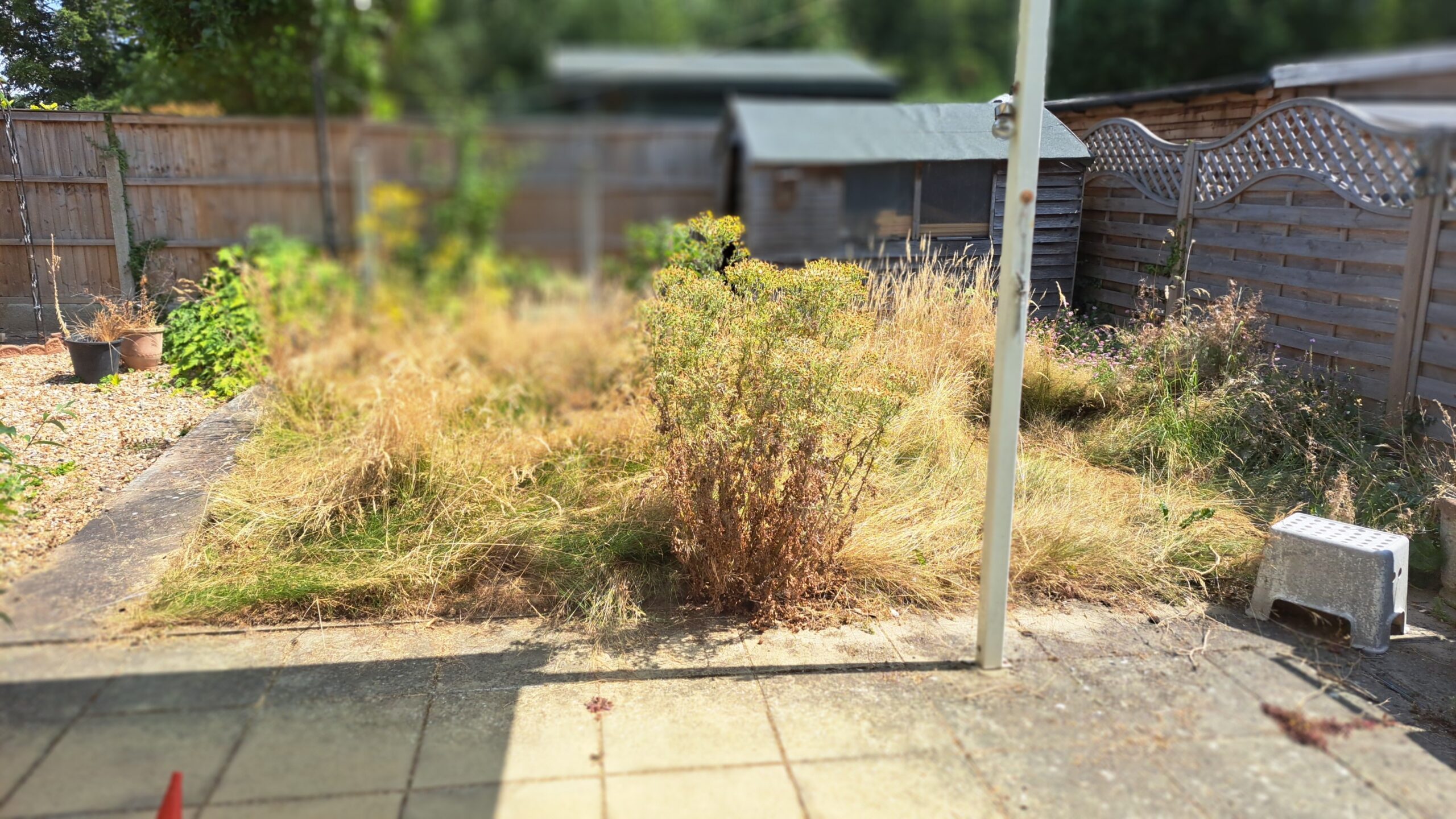
If you fail to receive a monthly NEWSBYTE, please look in spam, or reestablish the email by filling in the MAILING LIST form at the bottom of the front page of the website.

Many thanks.

Finally , please forward this email if you know someone who may be interested. Thanks.

Metta
Onward
Bodhidhamma

SATIPANYA  BUDDHIST TRUST
www.satipanya.org.uk
Directors  Jim Tibby  Richard Benjamin  Noirin Sheahan  Mike Regan  Gwen Sanderson
Limited Company Number  05924965  Registered Charity Number  1116668
Satipanya Buddhist Trust Satipanya White Gritt, Minsterley Shrewsbury, Shropshire SY5 0JN United Kingdom
T:  +44 (0)1588 650752
info:  [email protected]

JANUARY NEWSBYTE 2026
 

Trust all is well!

Worryingly, people keep disappearing from the mailing list. We don't know why.
If you realise you haven't received a Newsbyte, please rejoin the Mailing List at the bottom of the front page.


All Past Tips


For calendar and assistant opportunities, see below.

Tip o' the Day


 The Necessity of Cultivating JOY  
Bhante Bodhidhamma
See Below.

(Difficulty reading text? Press Ctrl +)

Calendar 2026 Application from 16 January

Practice in Daily Life (PODL)
Online support for Practice, Jan - March,
Led by Bhante,  Info here


See below for Retreats

Diary

Perhaps a little late in the day, my 80th loomed upon me all of a sudden. And I realised that I need to start up new teachers . All who I have worked with - Hui, Pierre and Mark - show great potential. Next year, I shall be adding Tisara and Josephine. And we also have Hannes Huber, a long established teacher. There are also others I would like to invite. Hopefully, over time there will be enough teachers to continue the long retreats. For this was the purpose of the centre, to offer a continuous programme for those who wanted to stay longer than the usual week or two. 

Returning from my retreat, there is always something that needs attending to. Noirin has been struggling with the air source heating system. The engineers can't find out what's wrong! Such is the problem with high-tech. When it works, it's a miracle. Once it malfunctions, you are thrown into a hell realm! We are now investing in oil heaters to cover all the rooms in the eventuality of shut down. That will definitely raise our heating costs and we are still having to bear the hike after Covid shut down, paying a huge c70p per kilowatt hour. Thankfully, this ends in February when we have a regular tariff.

And the final bit of news is that I shall be sending out information about the Manager role in a couple of weeks. It's all change at Satipanya!

Wishing you all a very fruitful year!
Hope to see you on the New Years Vigil and PODL!

Announcements

Personal Retreat:  Our retreat house in Bishops Castle "Sativasa" is now open for personal retreats. Suitable only for established meditators. Come for a week or longer. Retreats are self catering so the first day might need to be spent shopping, cooking etc. See here for more info. To apply email Bhante or Noirin .

Sharing the Path, Satipattthana Studies Part 1  has been published as an ebook , kindle , paperback and can be dowloaded as a PDF . Based on Noirin's Daily Life courses over previous years and supplemented by students' reflections, the book offers a study-practice guide to the Buddha's teaching on Mindfulness of Body, Feeling and Mind. Many thanks to Therese Caherty for editing. Further info here .

Meeting in London:   Satipanya London Sangha is a growing community of friendly and supportive meditators meeting in-person every month in a peaceful community garden near King's Cross station for group sits and lighthearted discussions.

If you'd like to attend upcoming meetings in London and practice vipassana in the tradition of Mahasi Sayadaw then join our WhatsApp group using  this link  and say hello, or  email Maz  if you have any questions.  

Regular Online Meetings:

Meditation Hall on Zoom:  Join us for your daily meditation -   Info.

Satipanya Spiritual Companions:  An informal meditation group meets on a monthly basis via Zoom for a full day of meditation. Email Magda for details at  [email protected]

Online Study Group: 
This collaborative online group studies various  dhamma topics across multiple traditions — so, not just Mahāsi practice. Carl says: We warmly extend an invitation to any practitioner who would like to join us. Currently meeting on the second and fourth Sundays of each month at 10:20am - around midday. Please contact Carl at  [email protected] for further information.

Full Moon Celebrations:  Join 20.00 to 21.00 on the Sunday closest to the Full Moon. Bhante gives a short dhamma talk, followed by a 30-min sitting, refuges and precepts and we end by reading and chanting the metta sutta.  For date of next Celebration.   
 
Opening to the Impact of the Climate Emergency:   Following on from the Zoom with Gwen Sanderson and Bhante Bodhidhamma in 2023, there are two options for ongoing engagement:
  • Gwen Sanderson is facilitating monthly Climate and Dhamma Conversations which are held using Zoom . Email Gwen for further information or to register. 
  • Noirin Sheahan has set up a Satipanya Forum focussing on the Six Maxims (ethical training to prepare for the social and environmental consequences of climate change). Contact Noirin for further info or to register.  

Karuna Book: Every morning at puja we call the names of those who are sick or dying, or are having a hard time.

Mudita Book: Every evening at puja we call the names of those who have something to rejoice.

Satipanya Courses

Vipassana as taught by the Mahasi Sayadaw of Burma

The Mahasi Sayadaw of Burma, one of the most influential vipassana insight meditation teachers of the last century, developed techniques to help us maintain moment to moment mindfulness from the instant we awake to the instant we fall asleep.

This leads not only to spiritual insights into our true, unborn-undying essence, but also, equally important, to the purification of the heart. So that we not only become wiser but more caring, generous, joyous and compassionate.

Applying the techniques on this retreat we follow a robust schedule, but meditators can modulate their practice to fit their level of experience, even absolute beginners. The accent is on relaxation and curiosity, rather than striving and concentration. And regular teacher contact, daily Q&A and personal interviews ensures students are supported throughout.

The retreat ends with advice on how to bring the practice into ordinary daily life to enhance our relationships and give spiritual meaning to our work and everyday tasks.

Assistants Needed

N.B. All the courses are serviced by assistants.

As assistant you have the opportunity to serve others. It can be a way of expressing gratitude for the gift of Dhamma. Although the morning is mainly taken up with breakfast preparation and cooking, the rest of day is for practice.

You can see the menus here (PDF).

As an assistant, we do not expect payment of the deposit or make a donation because you have kindly offered your time.

However, your commitment is essential, for the course would be very difficult to run without an assistant and may indeed have to be cancelled.

If you are interested, follow this link: Course Assistant

For info. about retreats and teachers see website: www.satipanya.org.uk
See drop down menus: especially About Us, Teachings and Retreats

Would you like to come and assist on a course?

See calendar on website for up-to-date assistant need.

Satipanya Calendar 2026

The 2026 Calanders is available for courses into January.
Please Note

Courses from late March into late summer open for application on
Friday, 16 January
Please apply only when you are certain to come.

The Necessity of Cultivating Joy
Sympathetic Joy, Reciprocal Joy.
Mudita

Bhante Bodhidhamma

There was never a time under my teachers in Theravada, who were all Burmese monks, the two most well-known were Sayadaw U Janaka and Sayadaw U Pandita, when I was given instructions on how to develop joy or compassion or equanimity. It was only metta we were encouraged to develop. Now there is a wisdom to that for once metta is developed, there is an easier response to suffering with compassion and to joy with joy.

However, joy is an Illimitable; it can be developed indefinitely. And it is a Divine Abode, one of the most beautiful mental states. And so important to balance compassion.

In a world which now manifests such suffering, causing us to feel depressed and hopeless, joy is an antidote. And if in a downcast mood we feel there is nothing to be joyful about, then we are not paying attention. We tend to be more aware of negativity, such as perceived dangers and for good reason, than we are of positivity. But if, on waking, we make a decision to be aware of how many times during the day we are in some degree of happiness, the work of developing joy is by that very attention enhanced.

So not only does developing joy balance any compassion it stops us falling into grief and apathy, but encourages us to action. It also undermines those negative states of envy and jealousy. As a distinguishing definition let us say that envy is wanting what the other has and jealousy the same but laced with hatred.

“Envy is abandoned by one who develops sympathetic joy.” Aṅguttara Nikāya 5.161 – Issā Sutta

To watch a parent rejoicing in their daughter’s or son’s success is to see how much more joy there is in being joyful for others. A joy shared is a joy squared. [i] In a work environment, where people, abandon blame and praise each other, all those bad feelings around rivalry, competition and subtle hostility are reduced. I’ve no doubt it increases productivity. So praising someone for their social or economic achievement has the effect of lessening resentment and selfishness, undermining that ego-self.

It is important to distinguish joy from excitement. Excitement is indulging in the feelings of joy and relies on some type of greed to keep it growing. When that fails, boredom sets in and the search for another ‘exciting thing to do’ starts all over. It becomes an addiction. Joy is a quiet, pleasant and at times very pleasant mental state, even to the point of Absorption, the jhana. It is always accompanied with calmness, equanimity. It never demands you keep it going. It is always an appropriate response to a joyful situation. And there’s no hankering after it when it passes.

Moreover, although it is complicated brain chemistry (for me!), in lay terms, the result of feeling in a down mood as a regular mood, changes the cell receptors so that the physical sensations to joyful moods are dampened. So, it is physiologically important to develop joyfulness! Since the body and mind (nama-rupa) are intermeshed, the body acts like a sounding board to mental states making our feeling tone that much more dense.

And for those who credit the possibility of rebirth:

“One who develops the liberation of mind by sympathetic joy
… is reborn in a happy destination.” Aṅguttara Nikāya 4.125

Mindheart (citta) is liberated of all unwholesome states, at least when the mindheart is in a state of joy.

So how do we develop Joy? As we develop Metta. Bring to mind someone who makes you feel joyful – little children, a pet, a joyful event, any joyful person. And use that as a touch stone and then go through the normal Metta process ending with all beings in all directions.

The blessings are simple: may you be joyful; may you be ever more joyful. And if it agrees with you: may you experience the sublime happiness of Nibbana.
Wishing you a very joyful 2026!


[i] A Swedish proverb, "Shared joy is double joy; shared sorrow is half a sorrow".

Calendar


If you fail to receive a monthly NEWSBYTE, please look in spam, or reestablish the email by filling in the MAILING LIST form at the bottom of the front page of the website.

Many thanks.

Finally , please forward this email if you know someone who may be interested. Thanks.

Metta
Onward
Bodhidhamma

SATIPANYA  BUDDHIST TRUST
www.satipanya.org.uk
Directors  Jim Tibby  Richard Benjamin  Noirin Sheahan  Mike Regan  Gwen Sanderson
Limited Company Number  05924965  Registered Charity Number  1116668
Satipanya Buddhist Trust Satipanya White Gritt, Minsterley Shrewsbury, Shropshire SY5 0JN United Kingdom
T:  +44 (0)1588 650752
info:  [email protected]

DECEMBER NEWSBYTE 2025
 

Trust all is well!

Worryingly, people keep disappearing from the mailing list. We don't know why.
If you realise you haven't received a Newsbyte, please rejoin the Mailing List at the bottom of the front page.


All Past Tips


For calendar and assistant opportunities, see below.

Tip o' the Day


  Cultivating Metta for Future Generations 
Noirin Sheahan
See Below.

(Difficulty reading text? Press Ctrl +)

Calendar 2026 is now open !


New Year's Eve Vigil - Online only
Starts 21.00, Join Bhante on Zoom - Info here

Practice in Daily Life (PODL)
Online support for Practice, Jan - March,
Led by Bhante,  Info here


See below for Retreats

Diary

Noirin here, Bhante is still on his annual retreat in Metta Vihara, he will return in Mid-December. We're now coming to the close of our 2025 retreat program, with Ven Obhasa leading Metta practice for the final fortnight. 

Meanwhile work to prepare the bungalow in Shrewsbury continues. Bhante will become resident there sometime in the new year as he steps back from day-to-day involvement with Satipanya, allowing his period of active leadership to come to a close.

Happily he will not be too far away and will continue to teach some retreats. And so the transition to Satipanya's second phase can occur gently and organically. To this end, many new teachers have joined the program over recent years, with Hui now taking a large share of Bhante's teaching, Guus taking on a second fortnight from next year, and Pierre Gallaz and Hannes Huber teaching for a fortnight each and Mark Arthur continuing his week-long course.  We hope Ven Vajiranani will return next year while
Carl hopes to add a weeklong to his current weekend offering.

In the new year we will start looking for a Household Manager to replace me, as I also fade into the background for my final years. My hope is to find somewhere conducive to letting the approach of death teach me about the deathless.  Any suggestions are welcome!    

Announcements

Full Moon Observance:  20.00 Sun 30 November   Metta and Forgiveness Practice.  Zoom links will be sent a few days in advance.

Personal Retreat:  Our retreat house in Bishops Castle "Sativasa" is now open for personal retreats. Suitable only for established meditators. Come for a week or longer. Retreats are self catering so the first day might need to be spent shopping, cooking etc. See here for more info. To apply email Bhante or Noirin .

Sharing the Path, Satipattthana Studies Part 1  has been published as an ebook , kindle , paperback and can be dowloaded as a PDF . Based on Noirin's Daily Life courses over previous years and supplemented by students' reflections, the book offers a study-practice guide to the Buddha's teaching on Mindfulness of Body, Feeling and Mind. Many thanks to Therese Caherty for editing. Further info here .

Meeting in London:   Satipanya London Sangha is a growing community of friendly and supportive meditators meeting in-person every month in a peaceful community garden near King's Cross station for group sits and lighthearted discussions.

If you'd like to attend upcoming meetings in London and practice vipassana in the tradition of Mahasi Sayadaw then join our WhatsApp group using  this link  and say hello, or  email Maz  if you have any questions.


Regular Online Meetings:

Meditation Hall on Zoom:  Join us for your daily meditation -   Info.

Satipanya Spiritual Companions:  An informal meditation group meets on a monthly basis via Zoom for a full day of meditation. Email Magda for details at  [email protected]

Online Study Group: 
This collaborative online group studies various  dhamma topics across multiple traditions — so, not just Mahāsi practice. Carl says: We warmly extend an invitation to any practitioner who would like to join us. Currently meeting on the second and fourth Sundays of each month at 10:20am - around midday. Please contact Carl at  [email protected] for further information.

Full Moon Celebrations:  Join 20.00 to 21.00 on the Sunday closest to the Full Moon. Bhante gives a short dhamma talk, followed by a 30-min sitting, refuges and precepts and we end by reading and chanting the metta sutta.  For date of next Celebration.   
 
Opening to the Impact of the Climate Emergency:   Following on from the Zoom with Gwen Sanderson and Bhante Bodhidhamma in 2023, there are two options for ongoing engagement:
  • Gwen Sanderson is facilitating monthly Climate and Dhamma Conversations which are held using Zoom . Email Gwen for further information or to register. 
  • Noirin Sheahan has set up a Satipanya Forum focussing on the Six Maxims (ethical training to prepare for the social and environmental consequences of climate change). Contact Noirin for further info or to register.  

Karuna Book: Every morning at puja we call the names of those who are sick or dying, or are having a hard time.

Mudita Book: Every evening at puja we call the names of those who have something to rejoice.

Satipanya Courses

Vipassana as taught by the Mahasi Sayadaw of Burma

The Mahasi Sayadaw of Burma, one of the most influential vipassana insight meditation teachers of the last century, developed techniques to help us maintain moment to moment mindfulness from the instant we awake to the instant we fall asleep.

This leads not only to spiritual insights into our true, unborn-undying essence, but also, equally important, to the purification of the heart. So that we not only become wiser but more caring, generous, joyous and compassionate.

Applying the techniques on this retreat we follow a robust schedule, but meditators can modulate their practice to fit their level of experience, even absolute beginners. The accent is on relaxation and curiosity, rather than striving and concentration. And regular teacher contact, daily Q&A and personal interviews ensures students are supported throughout.

The retreat ends with advice on how to bring the practice into ordinary daily life to enhance our relationships and give spiritual meaning to our work and everyday tasks.

Assistants Needed

N.B. All the courses are serviced by assistants.

As assistant you have the opportunity to serve others. It can be a way of expressing gratitude for the gift of Dhamma. Although the morning is mainly taken up with breakfast preparation and cooking, the rest of day is for practice.

You can see the menus here (PDF).

As an assistant, we do not expect payment of the deposit or make a donation because you have kindly offered your time.

However, your commitment is essential, for the course would be very difficult to run without an assistant and may indeed have to be cancelled.

If you are interested, follow this link: Course Assistant

For info. about retreats and teachers see website: www.satipanya.org.uk
See drop down menus: especially About Us, Teachings and Retreats

Would you like to come and assist on a course?

See calendar on website for up-to-date assistant need.

Satipanya Calendar 2026

The 2026 Calanders is available for courses into January.
Please Note

Courses from late March into late summer open for application on
Friday, 16 January
Please apply only when you are certain to come.

Cultivating Metta for Future Generations.

Noirin Sheahan

Following from last month’s tip, I want to explore additional Dhamma supports for last of the six maxims  suggested as ethical preparation for climate catastrophe .  The final maxim challenges to think beyond our close circle and act for the future generation of all species.

There are many ways we could do this - caring for the soil, for ecosystems, for political structures promoting long-term social well-being over short term gain. But unless we can do this with good will, we risk burning out, overwhelmed by the immensity of the task, demoralised by the cultural habits that fuel climate change and blind us to the coming catastrophe. To sustain our efforts we need to develop a metta (goodwill) practice which can encompass future generations.

Last month I described how the teaching: “ The whole world can be found in this fathom long body ” allowed me to use news and documentary images of climate related suffering to become an embodied aspect of ‘my world’ – the world of present experience – for the purpose of opening the heart to those beyond my immediate circle.

But when I tried applying this to developing metta for future generations, it didn’t work as I couldn’t imagine who or what I was directing metta towards.

Because the Metta Sutta asks us to extend goodwill and care to ‘those born and to be born’ , I guessed the Buddha would have provided some help with this aspect of metta practice and started looking for anything relevant.

The teaching I found particularly helpful is from the Samyutta Nikaya: “It would be better, bhikkhus, for the uninstructed worldling to take this body composed of the four great elements as self rather than the mind. For what reason? Because this body may last for ten, twenty, thirty, or forty years… But that which is called mind, intellect, or consciousness arises as one thing and ceases as another, both by day and by night.”

In other teachings the Buddha clarifies that he does not want us to identify with the body, because it cannot provide a reliable basis for happiness. At any moment the body may get injured or fall ill; if we live long enough it will grow frail and eventually will die. Beautiful sights and sounds, thrilling or tender touches – all these give temporary pleasure and we can use such pleasure to lift the heart: relaxing in a bath, having a massage, gazing at the sunset, sipping tea. But if we keep chasing one sense pleasure after another we’ll exhaust ourselves. None of them can ever satisfy our natural desire for lasting happiness.

In this teaching however, the Buddha tells us it would be better to identify with the body rather than the mind, because the body is a more trusty source of stability.

He says this applies to ‘an uninstructed worldling’, someone who doesn’t know the Dhamma.  This is true of all of us at times – when we’re on autopilot or caught in an emotional storm or getting fixated on an idea or somehow stuck in meditation. Our Dhamma knowledge has temporarily deserted us, we need to relearn it in this presenting moment.

What I really like about this teaching is that it gives us permission to make a mistake. For those of us who tend towards perfectionism, this is gold dust. We know it’s a mistake to identify with the body, but we do it anyway, assured that it’s the lesser mistake than following our current line of thought. Relaxing into the body, enjoying the temporary illusion of identity, some wiser thoughts start to appear in the mind.

I used this approach to develop metta for future generations. I pictured a cousin’s grandchild, tried to imagine him getting older, with his own children and grandchildren and the kind of world they might be living in. But trying to hold this in imagination along with goodwill was a step to far. The images kept collapsing and I began to feel resentful at being asked too much.  

I took the Buddha’s advice and let myself sink into identity with the body. It was a great relief to let go of the imaginative effort and lots of joy arose at simply being able to sit and breathe, to think of this as 'my body, my breath'.

Recognizing the relative stability of the body brought forth gratitude for the enduring nature of physical form in general, the house I was in, the earth itself, nature, the bodies of others.

Gratitude that my own body had already lasted several decades triggered memories of my grandparents.  It occurred to me that although I wasn’t able to imagine future generations, I could remember past ones, which seemed like a good way to ease back into the metta exercise. I recruited my grandparents in the flow of goodwill, imagining them wishing me and all their grandchildren well. It then because easy and natural for this metta to flow onwards to future generations.

At intervals thoughts and images suggesting future climate catastrophe brought the metta stream to a stop. Gripped by horror I again accepted the Buddha’s invitation to relax, let mental images fade, identify with the physical body, take the comfort it offered from being at this moment, safe, comfortable, well. This reminded me of the physicality of future generations – the bodies of people and animals that would be living then, the ground around them, the buildings or shelters they would inhabit. I sensed in all these the potential for strength and care and the basic blessing of survival. Metta flowed again, strengthened in fact, for having worked through the challenge.

The practice of identifying with the body whenever I feel stuck in meditation or lost in daily life has since proved a refuge on many occasions. I hope it will also prove a refuge for future generations facing challenges we are spared and that the intricate web of physical life on earth can continue to link beings with the Dhamma and hence with liberation.  
 

Calendar


If you fail to receive a monthly NEWSBYTE, please look in spam, or reestablish the email by filling in the MAILING LIST form at the bottom of the front page of the website.

Many thanks.

Finally , please forward this email if you know someone who may be interested. Thanks.

Metta
Onward
Bodhidhamma

SATIPANYA  BUDDHIST TRUST
www.satipanya.org.uk
Directors  Jim Tibby  Richard Benjamin  Noirin Sheahan  Mike Regan  Gwen Sanderson
Limited Company Number  05924965  Registered Charity Number  1116668
Satipanya Buddhist Trust Satipanya White Gritt, Minsterley Shrewsbury, Shropshire SY5 0JN United Kingdom
T:  +44 (0)1588 650752
info:  [email protected]

A Newsbyte