|
(Difficulty reading text? Press Ctrl +)
Assistant Needed
Winter Retreat with Bhante and Tisara:
Fri 09 - Sat 24 Jan
New Year's Eve Vigil
Starts 21.00, Join Bhante on Zoom - Info
here
Practice in Daily Life (PODL)
Online support for Practice, Jan - March,
Led by Bhante, Info
here
Satipanya London Sangha
Satipanya London Sangha is a growing community of friendly and supportive meditators meeting in-person every month in a peaceful community garden near King's Cross station for group sits and lighthearted discussions.
If you'd like to attend upcoming meetings in London and practice vipassana in the tradition of Mahasi Sayadaw then join our WhatsApp group using
this link
and say hello, or
email Maz
if you have any questions.
See below for Retreats
Noirin here, Bhante being away on his annual retreat in Metta Vihara.
The 8-week autumn retreat is now underway. Guus led the first fortnight and Hui is now leading the 4-week November retreat. We will finish with a fortnight of Metta Practice led by Sister Obhasa.
A few photos of autumn colours at Satipanya:
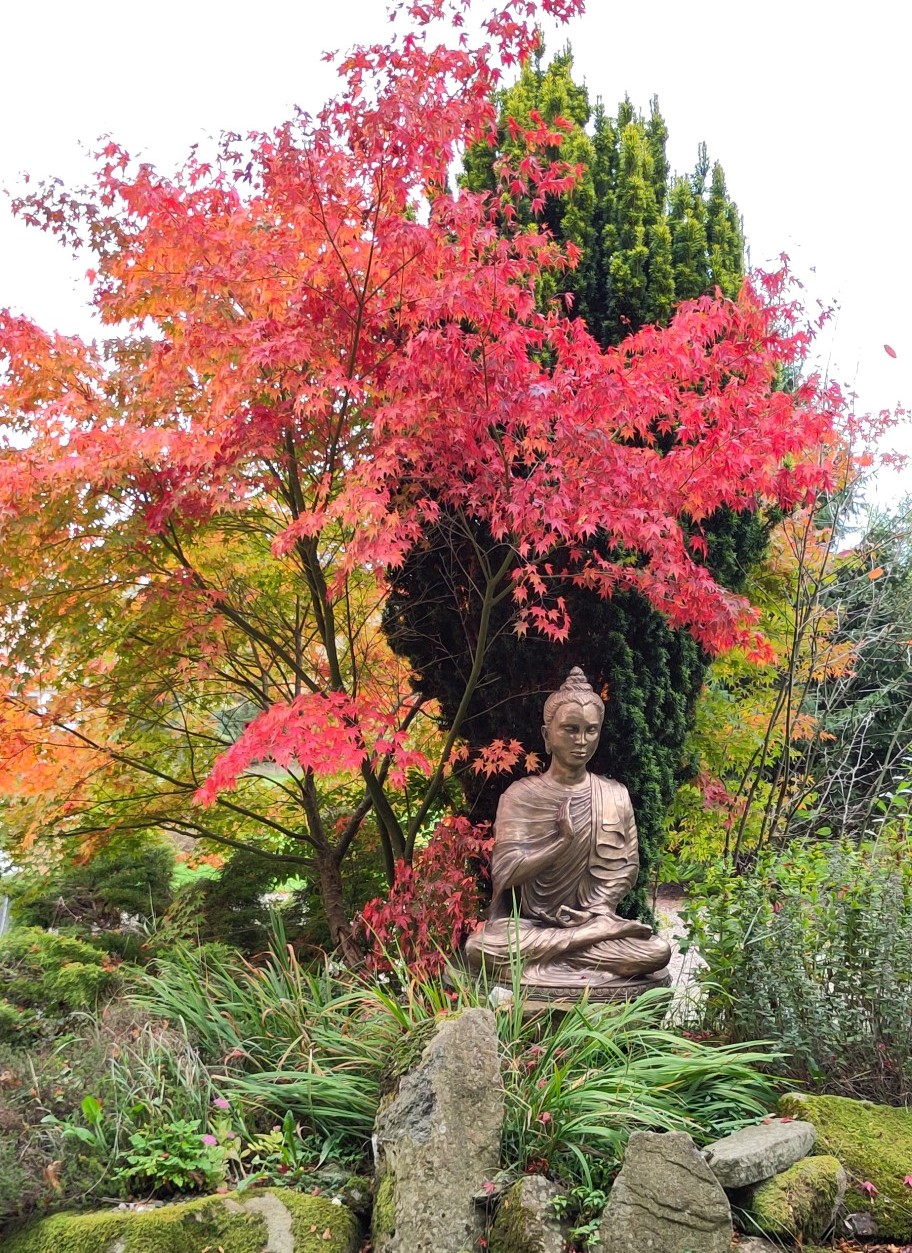
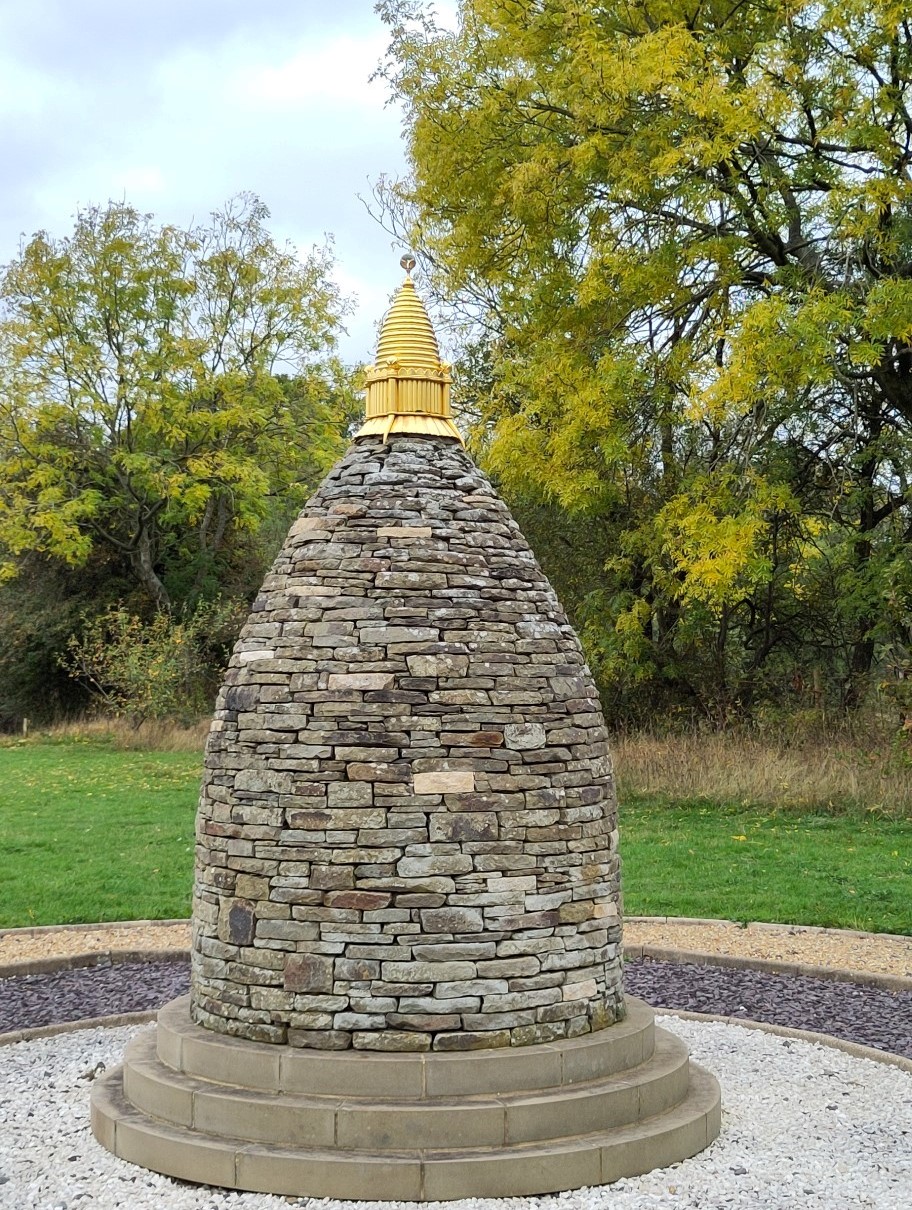
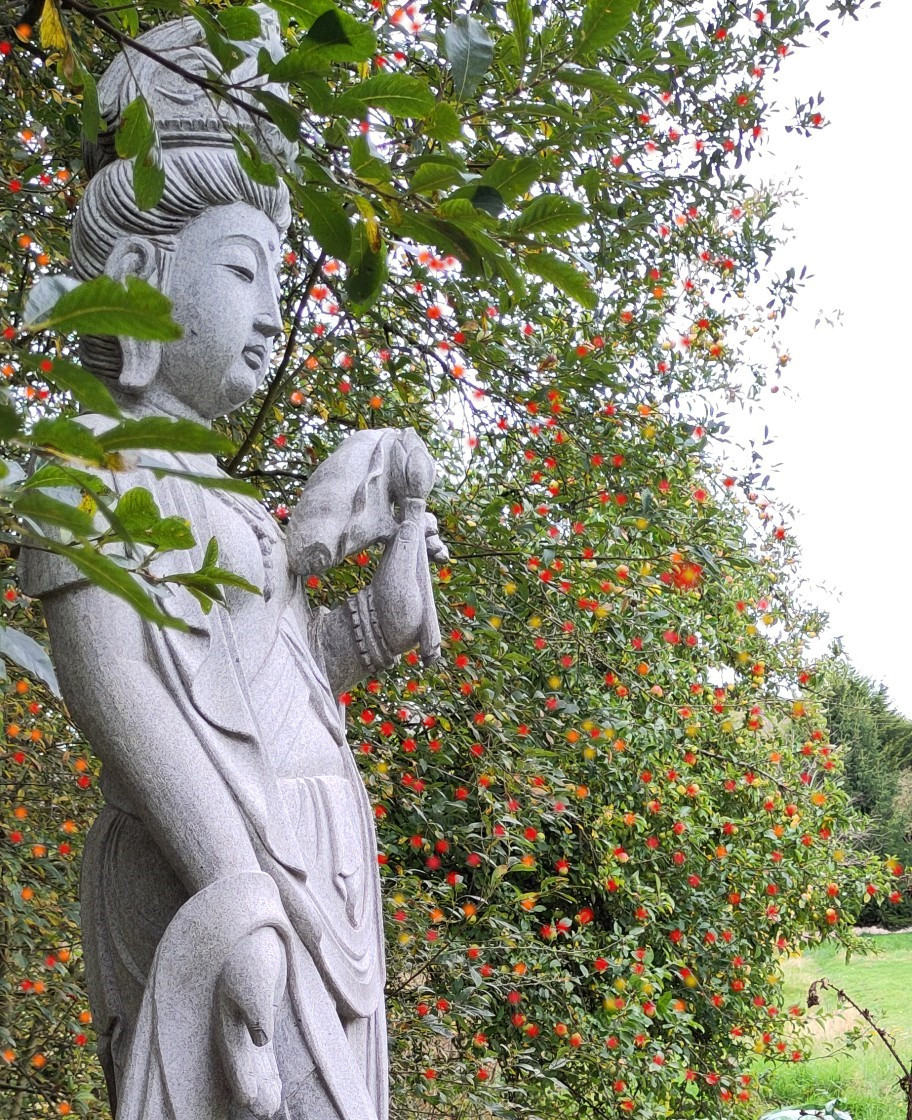
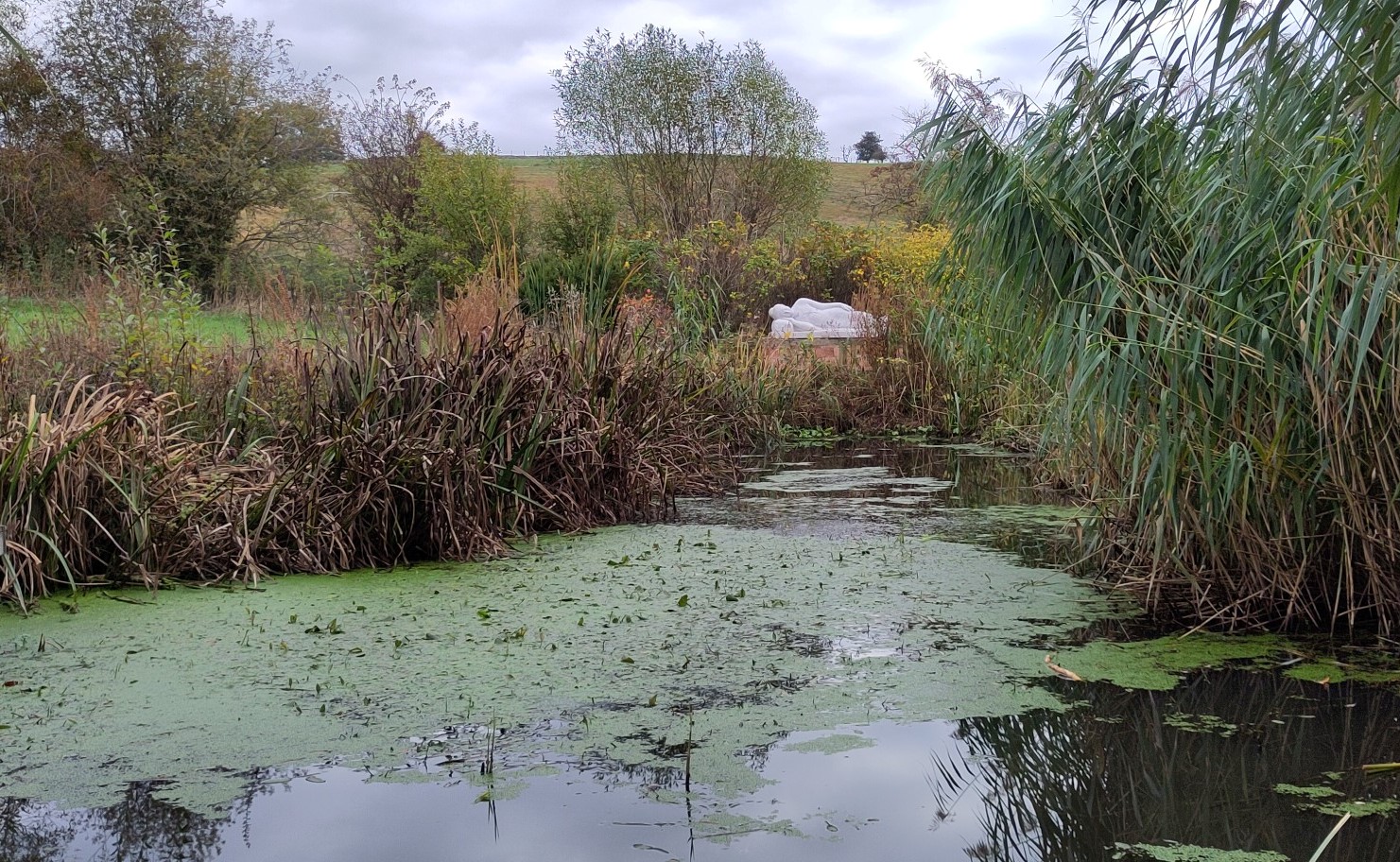
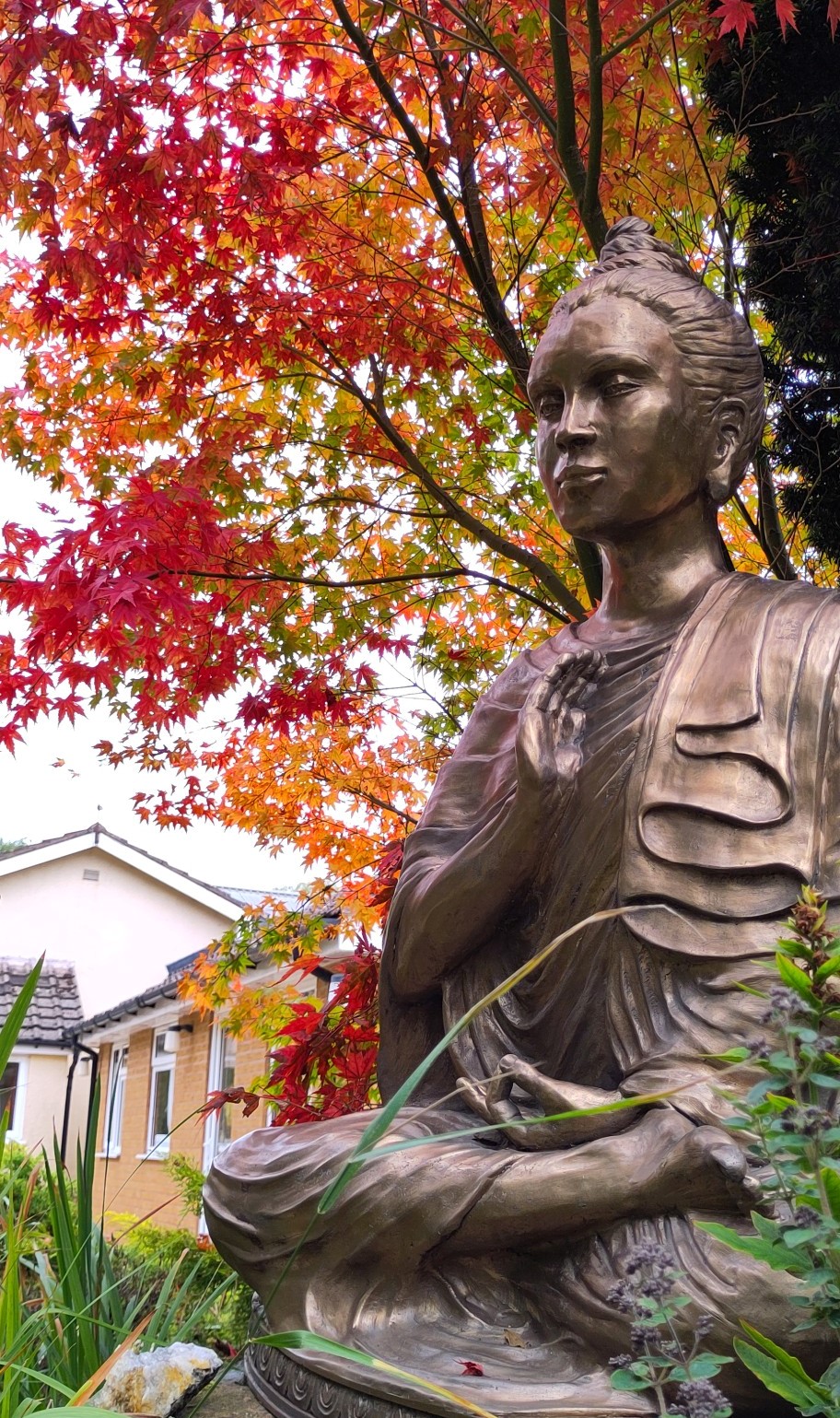
Many thanks to Jim Tibby for clearing so many reeds from the pond, it opens up the view. Beside Kwan Yin, the apple tree is laden with rosy fruit - most of which is tantalisingly out of reach! We have had a great crop of apples and pears this year. Plums grow wild in the hedgerows arround, I'm saving stones for Tomas to plant here next year, hopefully our own crop soon.
Announcements
Full Moon Observance:
20.00 Sunday 02 November
The Practice of the Five Contemplations,
20.00 Sun 30 November
Metta and Forgiveness Practice.
Zoom links will be sent a few days in advance
Our retreat house in Bishops Castle "Sativasa" is now open for personal retreats. Suitable only for established meditators. Come for a week or longer.
Retreats are self catering so the first day might need to be spent shopping, cooking etc. See
here
for more info. To apply email
Bhante
or
Noirin
.
has been published as an
ebook
,
kindle
,
paperback
and can be dowloaded as a
PDF
. Based on Noirin's Daily Life courses over previous years and supplemented by students' reflections, the book offers a study-practice guide to the Buddha's teaching on Mindfulness of Body, Feeling and Mind. Many thanks to Therese Caherty for editing. Further info
here
.
Meeting in London:
Maz, a fellow Satipanya meditator, is looking to see if others are interested in setting up a London based group once a month to meet in person and practice together in central London, or a location most convenient for those who are interested. If interested
email Maz
and let him know which areas in London are most convenient for you to meet.
Join us for your daily meditation -
Info.
An informal meditation group meets on a monthly basis via Zoom for a full day of meditation. Email Magda for details at
[email protected]
This collaborative online group studies various
dhamma
topics across multiple traditions — so, not just Mahāsi practice. Carl says: We
warmly extend an invitation to any practitioner
who would like to join us. Currently meeting on the second and fourth Sundays of each month at 10:20am - around midday. Please contact Carl at
[email protected]
for further information.
Join 20.00 to 21.00 on the Sunday closest to the Full Moon. Bhante gives a short dhamma talk, followed by a 30-min sitting, refuges and precepts and we end by reading and chanting the metta sutta.
For date of next Celebration.
Opening to the Impact of the Climate Emergency:
Following on from the Zoom with Gwen Sanderson and Bhante Bodhidhamma in September last year, there are two options for ongoing engagement:
-
Gwen Sanderson is facilitating monthly
Climate and Dhamma Conversations
which are held using
Zoom
. Email
Gwen
for further information or to register.
-
Noirin Sheahan has set up a Satipanya
Forum
focussing on the
Six Maxims
(ethical training to prepare for the social and environmental consequences of climate change - see tip below). Contact
Noirin
for further info or to register.
Every morning at puja we call the names of those who are sick or dying, or are having a hard time.
Every evening at puja we call the names of those who have something to rejoice.
Satipanya Courses
Coronavirus:
Requirements for visiting Satipanya.
We are asking everyone to take an antigen test before setting out in their journey to Satipanya and not to come if the test is positive.
Vipassana as taught by the Mahasi Sayadaw of Burma
The Mahasi Sayadaw of Burma, one of the most influential vipassana insight meditation teachers of the last century, developed techniques to help us maintain moment to moment mindfulness from the instant we awake to the instant we fall asleep.
This leads not only to spiritual insights into our true, unborn-undying essence, but also, equally important, to the purification of the heart. So that we not only become wiser but more caring, generous, joyous and compassionate.
Applying the techniques on this retreat we follow a robust schedule, but meditators can modulate their practice to fit their level of experience, even absolute beginners. The accent is on relaxation and curiosity, rather than striving and concentration. And regular teacher contact, daily Q&A and personal interviews ensures students are supported throughout.
The retreat ends with advice on how to bring the practice into ordinary daily life to enhance our relationships and give spiritual meaning to our work and everyday tasks.
Assistants Needed
N.B.
All the courses are serviced by assistants.
As assistant you have the opportunity to serve others. It can be a way of
expressing gratitude for the gift of Dhamma. Although the morning is mainly
taken up with breakfast preparation and cooking, the rest of day is for
practice.
You can
see
the menus here
(PDF).
As an assistant, we do not expect payment of the deposit or make a donation
because you have kindly offered your time.
However, your commitment is essential, for the course would be very difficult to
run without an assistant and may indeed have to be cancelled.
If you are interested, follow this link:
Course
Assistant
For info. about retreats and teachers see website:
www.satipanya.org.uk
See drop down menus: especially About Us, Teachings and Retreats
Would you like to come and assist on a course?
See
calendar on website
for up-to-date assistant need.
The 2025/2026 Calanders is available for courses into January.
Please Note
Courses from late March into late summer open for application on
Friday, 16 January
Please apply only when you are certain to come.
Sixth Maxim:
Act for the Future Generations of All Species.
Noirin Sheahan
This tip looks at the last of the
six maxims
which have been suggested as ethical preparation for climate catastrophe. This advises us to “act for future generations of all species”. Here’s how the authors elaborate:
Speak for those without voice: the poor, the future generations, other species. Speak for the forests, the seas, the mountains. Act, personally and politically, to limit the damage being done to the biosphere. Every 0.5° C increase avoided is a major victory and achievement.
We are to concern ourselves with the welfare of those far beyond our circle of friendship or kinship. The Buddha’s teaching on compassion asks the same, and these lines from the Metta Sutta link closely with the maxim:
Whatever living beings there may be,
Whether they be weak or strong, omitting none,
The great or the mighty, medium, short or tall,
The seen and unseen,
Those living near or far away, born or to-be-born,
may all beings be at ease!
The words are easy to say, but challenging to put into action.
Weak or strong omitting none.
Considering climate change, the weak could be considered as those currently suffering, for example peoples in East Africa who have suffered decades of drought with resultant famine, homelessness and political instability, war and mass migration. The strong could be considered as those in relatively stable environments like Europe and the US, long beneficiaries of the resource-hungry technologies causing climate change.
It's helpful to bring both weak and strong together as the tendency to blame can find no suitable resting place – neither the climate refugees nor the far-right activists opposing them, nor the climate deniers exacerbating the crisis.
Weak and strong, omitting none.
Neither can we console ourselves by ignoring the forecasts of what our grandchildren may have to face:
Those born and to be born; May all beings be at ease.
To “act for future generations of all species” is to consider the whole world, to let the mind linger on wildfires, floods, drought and the devastation these bring for people and wildlife as well as nature itself, the essential basis for new generations.
When considering the world in this way, I’ve found it helpful to remember the Buddha’s teaching that
the whole world can be found within this fathom long body
. ‘The world’ here means the totality of our experience. In meditation we are normally focussed on our inner world of sensations and feelings. While working with this maxim, the totality of our experience includes our thoughts and imaginings of the outer world, planet earth with all its inhabitants.
Imaging drought and starvation brings tension: the jaws clench, the eyes wince. We usually ignore these seemingly trivial reactions but they are a key to the conundrum of compassion: how do I open the heart to the suffering of the world without causing myself to suffer?
Here is an example of working with this conundrum from my own experience.
Remembering that
‘the world can be found within this fathom long body’
draws awareness towards the physical tension in my jaws, eyes and elsewhere. This gives me the objectivity needed to register aversion, the attempt to get rid of suffering. Tracking the pushing sensations of aversion I realise that I am attempting to push away the imagined suffering so that ‘I’ can be above it all, directing good wishes towards those who suffer.
At times I sense this image of myself as superior, powerful, full of resources, while ‘the world’ is weak and needy. This is pity, easily confused with compassion. As I acknowledge pity, I notice how exhausting it is to imagine myself above the suffering of the world, how much effort I have to put into my good wishes. In time I run out of steam and sense myself as drowning in the imagined suffering of the world. Anger, blame and despair compete for attention as I scrabble to get back on top of things. This is overwhelm, compassion fatigue, burn-out.
Mindfully tracking experience as it bobs between these extremes, I find myself drawn towards a middle ground where the distinction between ‘me’ and ‘the suffering of the world’ is not so pronounced. This is a kind of no-mans-land and the lack of direction can be disconcerting, but since pity and overwhelm are dead ends I have no choice but to explore this territory.
I sense my boundaries loosening as mental images and thoughts are pulled downwards into the body, making everything feel unstable, uncertain. It’s nerve-wracking and the breath becomes jerky, but if I can stick with it long enough, a joyful fascination makes itself felt. Unpleasant sensations grow more pronounced, but habitual aversion towards them is held in check. I am now sensing these sensations as my best attempt to become conscious of the suffering of the world, while holding them in awareness is recognized as my best attempt at compassion. Although the sensations are unpleasant, the holding feels pleasant and thus a tentative equilibrium forms.
Within this equilibrium, I see that the unpleasant sensation are caused by anger, which is being directed at the felt sense of myself as responsible for fixing this problem. With that, the expectation that I should be able to fix the problem fades. Instead of there being a bubble of ‘me’ holding all the responsibility to save the world, the resources now seem to be shared equally. I sense a growing confidence that an essential goodness will continue no matter what devastation may be forthcoming.
The endevor to expand my circle of goodwill has dissolved a layer of delusion, demonstrating the link between wisdom and compassion.
With this more balanced perspective, it becomes easier to think about practical ways I could help – which charities I could support, which actions I could take as a personal or political level.
The sixth maxim challenges us to expand our circle of concern towards all the inhabitants of the earth, including nature itself. The Buddha’s teaching that ‘
the whole world can be found within this fathom-long body’
provides a practical way to open the heart to meet this challenge.
Calendar
If you fail to receive a monthly NEWSBYTE, please look in spam, or reestablish the
email by filling in the
MAILING LIST form
at the bottom of the front page of the website.
Many thanks.
Finally
, please forward this email if you know someone who may be
interested. Thanks.
|

