|
(Difficulty reading text? Press Ctrl +)
: Sunday 19 May,
7.30pm start - note earlier time!
Buddha Day Celebration:
Saturday 25th May
Retreat Places available June and July
Noirin here again, Bhante is teaching the first month of the spring-summer retreat.
As Richard explained in the Treasurer's Report last month, the Trust is hoping to buy a property in Bishops Castle where a manager could lodge. We're considering a house that's presently on the market - near the town centre, reasonably priced and and with a garden shed that could be converted to act as a meeting room for a local group. We're now awaiting a structural engineers report before we go further with the purchase.
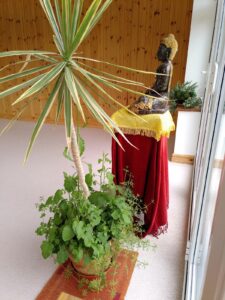
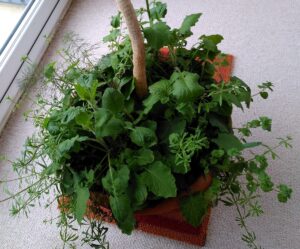
Meanwhile spring has finally arived with its chlorophyll explosion (as Rob, our electrician, calls it) bringing surprise company for the dragon tree in the walking room. Andy filled up the pot with top-soil during the winter. Hundreds of wildflower seeds found themselves being fed and watered regularly as well as having the sun beam upon them through the window. The result is gorgeous - weeds we hardly look at in the meadows are showing their true glory!
Announcements
Buddha Day, Sat 25th May:
Arive 11.30 for lunch at 12. Bring cold food to share. Ceremony 13.30 - 15.00: Dhamma talk, Loving Kindness, Refuges and Precepts, Procession around stupa and statues. Tea and Biscuits afterwards.
Spring Daily Life Course:
This year's on-line study-practice course focusses on the Seven Factors of Enlightenment. It;s being led by Noirin and further information is available
here
. Contact
Noirin
to register.
Northwest area Satipanya Sangha:
Anyone living in the northwest, particularly in Chester, Manchester, Liverpool and surrounding areas who would like to explore options for practicing together please contact
Martin Ratcliffe
who hopes to form a local group.
Join us for your daily meditation - 06.00, 09.00, 14.00, 16.00 and 20.00 sits.
Info.
An informal meditation group meets on a monthly basis via Zoom for a full day of meditation. Email Magda for details at
[email protected]
This collaborative study group is currently studying
the
jhāna
s, as taught by Rob Burbea
, in order to better understand this mainstay of the suttas, and how they contribute to the practice of
vipassanā
. We
warmly extend an invitation to any practitioner
who would like to join us. Currently meeting on the second and fourth Sundays of each month at 10:20am - around midday. Please contact Carl at
[email protected]
for further information.
Join 20.00 to 21.00 on the Sunday closest to the Full Moon. Bhante gives a short dhamma talk, followed by a 30-min sitting, refuges and precepts and we end by reading and chanting the metta sutta.
For date of next Celebration.
Opening to the Impact of the Climate Emergency:
Following on from the Zoom with Gwen Sanderson and Bhante Bodhidhamma in September last year, there are two options for ongoing engagement:
-
Gwen Sanderson is facilitating monthly
Climate and Dhamma Conversations
which are held using
Zoom
. Email
Gwen
for further information or to register.
-
Noirin Sheahan has set up a Satipanya
Forum
focussing on the
Six Maxims
(ethical training to prepare for the social and environmental consequences of climate change - see tip below). Contact
Noirin
for further info or to register.
Every morning at puja we call the names of those who are sick or dying, or are having a hard time.
Every evening at puja we call the names of those who have something to rejoice.
Satipanya Courses
Coronavirus:
Requirements for visiting Satipanya.
We are asking everyone to take an antigen test before setting out in their journey to Satipanya and not to come if the test is positive.
Vipassana as taught by the Mahasi Sayadaw of Burma
The Mahasi Sayadaw of Burma, one of the most influential vipassana insight meditation teachers of the last century, developed techniques to help us maintain moment to moment mindfulness from the instant we awake to the instant we fall asleep.
This leads not only to spiritual insights into our true, unborn-undying essence, but also, equally important, to the purification of the heart. So that we not only become wiser but more caring, generous, joyous and compassionate.
Applying the techniques on this retreat we follow a robust schedule, but meditators can modulate their practice to fit their level of experience, even absolute beginners. The accent is on relaxation and curiosity, rather than striving and concentration. And regular teacher contact, daily Q&A and personal interviews ensures students are supported throughout.
The retreat ends with advice on how to bring the practice into ordinary daily life to enhance our relationships and give spiritual meaning to our work and everyday tasks.
Assistants Needed
N.B.
All the courses are serviced by assistants.
As assistant you have the opportunity to serve others. It can be a way of
expressing gratitude for the gift of Dhamma. Although the morning is mainly
taken up with breakfast preparation and cooking, the rest of day is for
practice.
You can
see
the menus here
(PDF).
As an assistant, we do not expect payment of the deposit or make a donation
because you have kindly offered your time.
However, your commitment is essential, for the course would be very difficult to
run without an assistant and may indeed have to be cancelled.
If you are interested, follow this link:
Course
Assistant
For info. about retreats and teachers see website:
www.satipanya.org.uk
See drop down menus: especially About Us, Teachings and Retreats
Would you like to come and assist on a course?
See
calendar on website
for up-to-date assistant need.
The 2024 Calander is available for courses into September.
You can apply any time, but please only when you are certain.
Fifth Maxim: Develop the Body and Mind
Noirin Sheahan
This tip looks at the 5
th
of the
six maxims
which have been suggested as ethical preparation for climate catastrophe. The authors, David Schenck and Larry Churchill, believe that we are heading towards social collapse due to the unstoppable consequences of Climate Change and that the trauma of losing so much of what we take for granted – like food, water, social stability – will lead to huge levels of stress and mental illness. My purpose in writing these tips is to tease out some links between these maxims and the Dhamma.
The fifth maxim advises us to train the body and mind. Here’s what they say:
Learn breathing exercises. Develop the physiological capacity to deal with despair. Despair isn’t just psychological, it’s physiological. Learn skills for getting beyond ego—not just the cognitive limits of ego, which many are at least familiar with pondering, but the emotional and physiological limits of ego.
Training the mind is central to the Dhamma. The first verse of the Dhammapada tells us that all our suffering is mind-made:
Speak or act with an impure mind -
Suffering follows, just as the wheel of the ox-cart follows the footsteps of the ox.
Speak or act with a pure mind -
Happiness follows, as surely as our shadow follows our footsteps.
Although the body plays a central role in the Buddha’s teaching, it is always as a means for training the mind. In a similar vein, the six maxim authors aren’t advocating fitness for its own sake, but for the sake of dealing with despair. Thus their advice has many resonances with the Dhamma:
Breathing exercises:
The Anapanasati Sutta lists a number of breathing exercises. These start with mindfulness, knowing when we’re breathing in and when we’re breathing out. They include the kind of yogic breathing exercises David and Larry are indicating e.g. using the breath to calm the body and mind, to develop pleasant feeling, to gladden the mind & develop concentration.
The need to deal with despair
: Despair was what fuelled the Buddha’s quest for enlightenment: his early life of luxury was rendered meaningless once he realised that this would end in sickness, aging and death. His whole teaching, he said, could be reduced to a simple statement:
there is suffering and there is an end to suffering.
Having transcended his own despair we can be confident that the Dhamma will teach us to do likewise.
Develop the physiological capacity to deal with despair:
The Buddha’s first attempts at spiritual development started with deeply concentrated forms of meditation. Seeing these gave only a temporary respite from despair he went on to practice strenuous asceticism. On the verge of death from starvation and hardship he abandoned this approach, accepted a bowl of rice-milk and went on to discover his own path to liberation. Taking the rice-milk indicates the need for physical energy in order to make his spiritual breakthrough. While body building isn’t lauded as a virtue in his teaching, he encouraged people to maintain good health e.g. to do walking meditation so as
to develop energy, health and aid digestion
; to eat healthy food like rice-gruel so as to
enjoy health, strength and a comfortable abiding.
Ego limitations manifest not only cognitively, but emotionally and physiologically:
In Dhamma terminology, we suffer because we cling to the wrong view of self. This suffering manifests as emotional burdens like greed and aversion, which have physical aspects – for some it might be muscular tension, for others headaches, stomach upsets, breathing difficulties.
Getting beyond the ego:
This is one way of describing the teaching on ‘Not-Self’. Believing there is a substantial core to the person we call ‘me’, we suffer when things go wrong for us – when we get blamed or mistreated, when we fall ill or become incapacitated, when we lose those we love. The Buddha does not deny the suffering, or the fact that it is happening to the person I call ‘me’. Caring deeply for that person, he would respond with compassion, while knowing the suffering as unnecessary, based on mistaken identification with body and mind, with the person called ‘me’. All our practice is aimed at seeing through this illusion, so as to gain the peace and joy of liberation.
This penultimate maxim resonates well with the Buddha’s teaching. Despair will emerge for all of us as we witness the increasing impact of climate change on nature, on vulnerable communities as our own food supplies and social structures grow ever less reliable. Can we take the coming storm to heart, prepare ourselves as advised in the 5
th
Maxim? If we care for our body as the necessary basis for learning the Dhamma, train body and mind according to the Anapanasati and other suttas, we will be ready to let it become part of our path to the end of suffering.
When despair becomes widespread in society, those of us who can meet it mindfully will become ever more important in preserving hope, preventing a decline into chaos.
If you fail to receive a monthly NEWSBYTE, please look in spam, or reestablish the
email by filling in the
MAILING LIST form
at the bottom of the front page of the website.
Many thanks.
Finally
, please forward this email if you know someone who may be
interested. Thanks.
|

