|
(Difficulty reading text? Press Ctrl +)
Noirin here, Bhante still on his annual retreat in
Mettā Vihāra,
Germany.
The purchase process for the house in Bishops Castle is now complete and we are starting to furnish so that it can be used for personal retreats and for local group meetings. We hope it will be ready by spring. In the longer term we envisage a Satipanya manager living there and travelling the 6 miles to work here at the retreat centre. This purchase is an important milestone in ensuring Satipanya's future when Bhante and I succumb to the ravages of sickness, ageing and (not too soon hopefully!) death.
Many of you will know Julian Holdsworth who comes regularly to Satipanya on retreat. Julian lives in Keswick and having accrued a sizable collection of Buddhist texts from his studies which started in the mid 1970s, he decided to share his knowledge, founding the Keswick Theravada Buddhist group. This provided a space where people could come together to investigate the Buddha-Dhamma. On the 35th anniversary of the group's foundation, we congratulate Julian for enriching so many lives and hope others will be inspired to follow suit. Sadhu Julian!
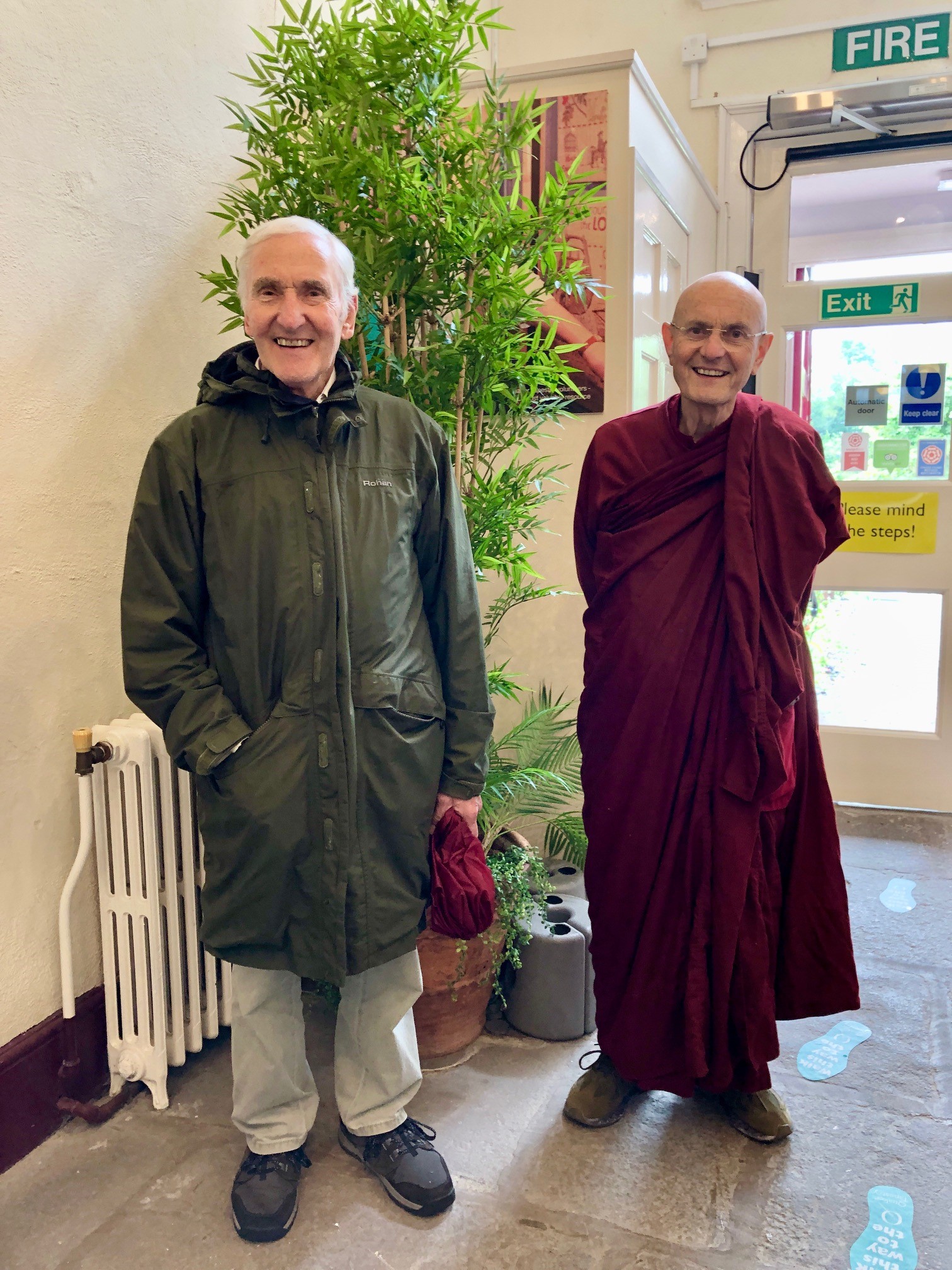
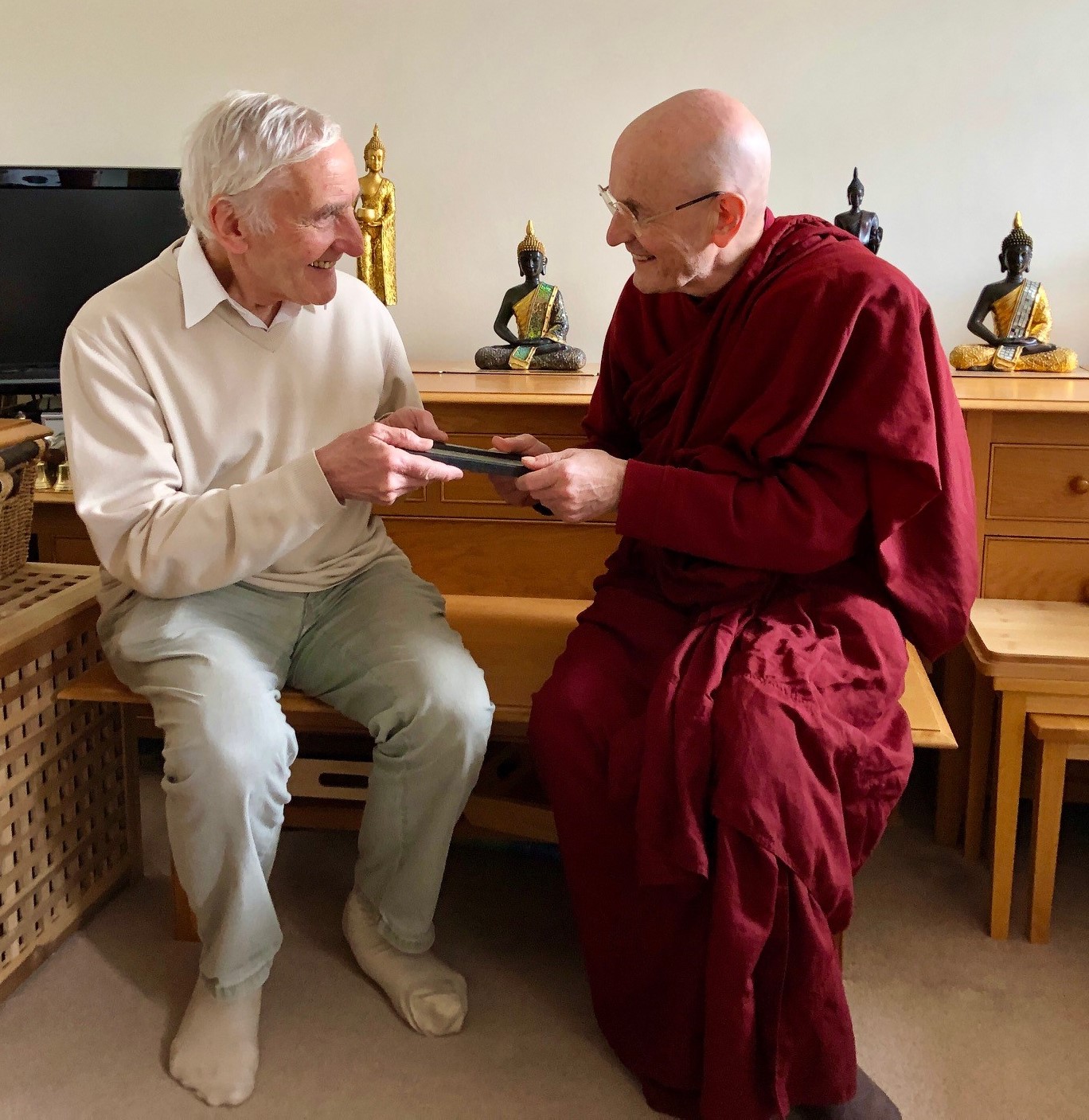
Photos of Bhante and Julian at the Quakers meeting house in Kendal, and of Bhante presenting Julian with his Teaching Certificate.
Announcements
Northwest area Satipanya Sangha:
Anyone living in the northwest, particularly in Chester, Manchester, Liverpool and surrounding areas who would like to explore options for practicing together please contact
Martin Ratcliffe
who hopes to form a local group.
Join us for your daily meditation - 06.00, 09.00, 14.00, 16.00 and 20.00 sits.
Info.
An informal meditation group meets on a monthly basis via Zoom for a full day of meditation. Email Magda for details at
[email protected]
This collaborative study group is currently studying
the
jhāna
s, as taught by Rob Burbea
, in order to better understand this mainstay of the suttas, and how they contribute to the practice of
vipassanā
. We
warmly extend an invitation to any practitioner
who would like to join us. Currently meeting on the second and fourth Sundays of each month at 10:20am - around midday. Please contact Carl at
[email protected]
for further information.
Join 20.00 to 21.00 on the Sunday closest to the Full Moon. Bhante gives a short dhamma talk, followed by a 30-min sitting, refuges and precepts and we end by reading and chanting the metta sutta.
For date of next Celebration.
Opening to the Impact of the Climate Emergency:
Following on from the Zoom with Gwen Sanderson and Bhante Bodhidhamma in September last year, there are two options for ongoing engagement:
-
Gwen Sanderson is facilitating monthly
Climate and Dhamma Conversations
which are held using
Zoom
. Email
Gwen
for further information or to register.
-
Noirin Sheahan has set up a Satipanya
Forum
focussing on the
Six Maxims
(ethical training to prepare for the social and environmental consequences of climate change - see tip below). Contact
Noirin
for further info or to register.
Every morning at puja we call the names of those who are sick or dying, or are having a hard time.
Every evening at puja we call the names of those who have something to rejoice.
Satipanya Courses
Coronavirus:
Requirements for visiting Satipanya.
We are asking everyone to take an antigen test before setting out in their journey to Satipanya and not to come if the test is positive.
Vipassana as taught by the Mahasi Sayadaw of Burma
The Mahasi Sayadaw of Burma, one of the most influential vipassana insight meditation teachers of the last century, developed techniques to help us maintain moment to moment mindfulness from the instant we awake to the instant we fall asleep.
This leads not only to spiritual insights into our true, unborn-undying essence, but also, equally important, to the purification of the heart. So that we not only become wiser but more caring, generous, joyous and compassionate.
Applying the techniques on this retreat we follow a robust schedule, but meditators can modulate their practice to fit their level of experience, even absolute beginners. The accent is on relaxation and curiosity, rather than striving and concentration. And regular teacher contact, daily Q&A and personal interviews ensures students are supported throughout.
The retreat ends with advice on how to bring the practice into ordinary daily life to enhance our relationships and give spiritual meaning to our work and everyday tasks.
Assistants Needed
N.B.
All the courses are serviced by assistants.
As assistant you have the opportunity to serve others. It can be a way of
expressing gratitude for the gift of Dhamma. Although the morning is mainly
taken up with breakfast preparation and cooking, the rest of day is for
practice.
You can
see
the menus here
(PDF).
As an assistant, we do not expect payment of the deposit or make a donation
because you have kindly offered your time.
However, your commitment is essential, for the course would be very difficult to
run without an assistant and may indeed have to be cancelled.
If you are interested, follow this link:
Course
Assistant
For info. about retreats and teachers see website:
www.satipanya.org.uk
See drop down menus: especially About Us, Teachings and Retreats
Would you like to come and assist on a course?
See
calendar on website
for up-to-date assistant need.
Full Awareness
Noirin Sheahan
The Buddha asks us to act in ‘full awareness’ when we go about the ordinary tasks of daily life. The first exercise he prescribes is full awareness while going forth and returning.
Say we are walking to our workplace. As we note the sensations of walking in the legs and feet, attention is drawn into the present moment. For full awareness the context must also be born in mind: we are going to work. Full awareness requires a broad understanding of our actions alongside the stream of sensations that accompanies them.
Instead of the detailed note we use for Mahasi practice, broad-brush phrases work better here. On our way to work we can note: ‘Going to work… going to work.’ Sounds obvious but how easy it is to forget the bigger picture. We go to work on autopilot, so familiar with every step of the journey that we can devote our time to worrying or daydreaming. The note ‘going to work’ lifts us out of the doldrums, lets us feel more purposeful, helps us appreciate our surroundings.
Reminding ourselves of the broader context can expose hidden emotions. We might feel a deep reluctance to note ‘going to work’, for example, but feel happy later in the days as we retrace our steps, noting ‘going home’. This highlights a negative attitude to work. If we do not make the note, that negativity might sneak out as carelessness, not bothering to finish tasks properly, alienating colleagues and making the situation worse.
However, if we note ‘going to work’ the weariness or anxiety or depression we associate with work comes to the fore. Although it might
feel
worse than heading for the job on autopilot, bearing with the feelings means the negativity can be acknowledged. Acknowledging suffering is a form of self-care and has a very beneficial impact psychologically. We are much less likely to act from negativity once we’re aware of it. We might even start noting satisfaction in completing a task, finding pleasure in cooperating with colleagues. Imperceptibly, perhaps, the situation starts to improve.
Even for less emotionally charged activities, the experience of going forward can differ from returning. Say I have to nip down to the shop for groceries. I may be bright and purposeful at the outset. My step is light and I look with interest at the neighbour’s gardens. Coming home my steps might be more plodding, my eyes downcast. What I am seeing here is the dukkha of transience. Each new activity offers a glimmer of hope that this world can make us happy. But when the choice between carrots and broccoli, biscuits and cake have been made and all the money spent, it becomes clear that my shopping spree has not delivered the goods I was secretly hoping for.
Of course the pattern can vary. For instance, the prospect of meeting friends may find us brighter on the way home than heading out. Worthwhile noting as it helps us appreciate our friends when we see how they lift our mood.
The second task the Buddha prescribes is to be fully aware when looking ahead and looking away. Say we are returning from the shops on autopilot, rehashing our problems, eyes vaguely scanning the pavement. Now and again, we look up and ahead in a semi-automatic check of the broader environment. If we have primed ourselves to see ‘looking ahead’ as worth registering, that automatic check might awaken mindfulness. Looking ahead also reminds us of our destination, so we can return to full awareness instead of being lost in negativity.
While looking ahead is often stimulating, looking away often carries subtle dukkha. A friend practising mindfulness of speech found that when reacting against what another person was saying, her eyes turned slightly aside. Once she had detected the pattern, she was able to use this as a ‘wake-up’ call to notice aversion. Her communication could then be much more honest and straightforward.
Full awareness does not mean self-awareness. Say we are preparing dinner. We may be cutting carrots, totally absorbed in the task. Then suddenly we become aware of ‘me’ who is cutting carrots and worry that we weren’t being mindful because we hadn’t been self-aware. That’s a mistake. If we hadn’t been lost in thought while cutting carrots, then we were being mindful. The sense of self comes and goes and can disappear altogether when we are fully absorbed in an activity.
Following the Buddha’s exercises for Full Awareness supports mindfulness throughout all aspects of daily life. Instead of taking ourselves and our situation for granted we wake up to the extraordinary treasure we call awareness.
If you fail to receive a monthly NEWSBYTE, please look in spam, or reestablish the
email by filling in the
MAILING LIST form
at the bottom of the front page of the website.
Many thanks.
Finally
, please forward this email if you know someone who may be
interested. Thanks.
|

